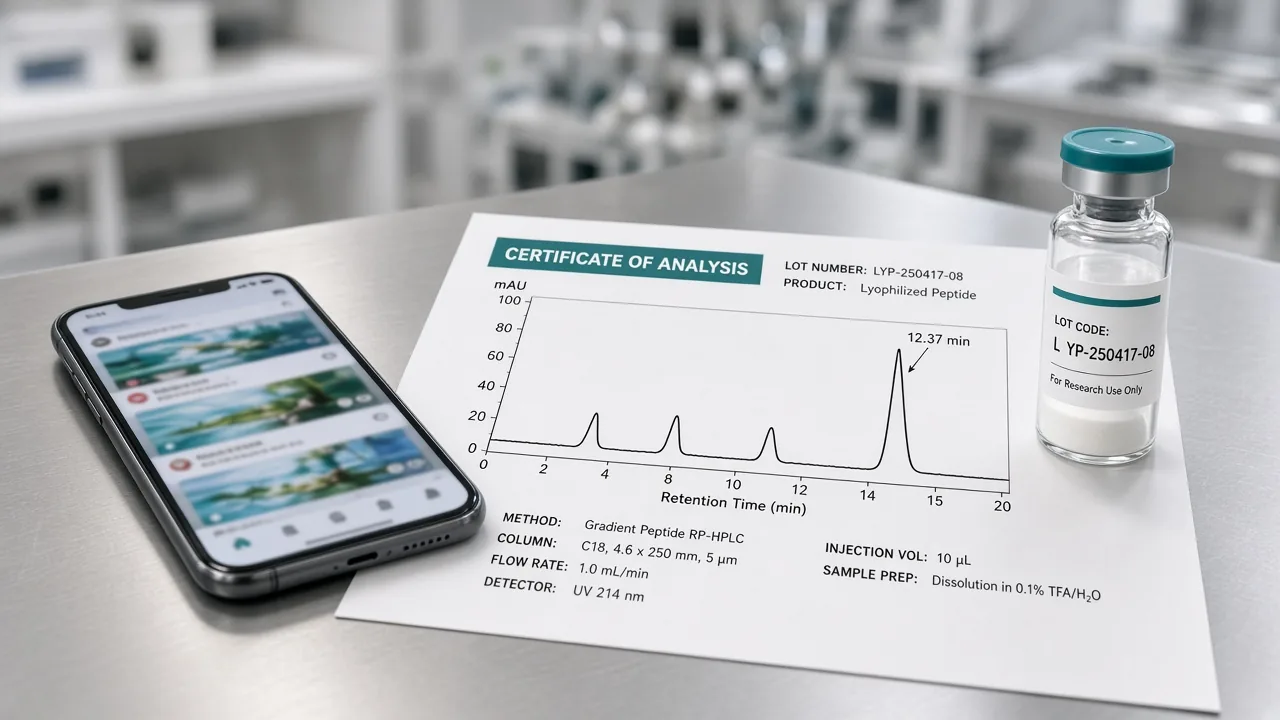
Why Manufacturing Source and Verification Matter in Research Peptide Quality
Tetrava Labs Editorial Team11 min read
A research peptide COA is useful only when it connects a named test, a specific lot, and reviewable analytical evidence. This guide explains manufacturing risk and gives readers a reproducible 12-point COA audit.

Introduction
Research peptide quality cannot be inferred from a polished label, a claimed manufacturing country, or a single percentage printed on a certificate of analysis (COA). A defensible quality record connects the material's manufacturing source, the received lot, the sampling event, the analytical methods, and the reported data. If one link is missing, the record may describe a peptide in theory without establishing what is inside the vial under review.
This distinction matters for research-use-only (RUO) materials because the label defines an investigational laboratory purpose, not FDA approval of the product. FDA guidance explains how RUO and investigational-use-only labeling applies to in vitro diagnostic products and when surrounding conduct can conflict with that label. For a practical starting point, readers can inspect lot-linked COA library published by Tetrava Labs. The library is a place to review available records; it is not a substitute for evaluating each record against the lot in hand.
Manufacturing source changes the risk profile
Modern peptide production commonly draws on solid-phase peptide synthesis, the method introduced by R. B. Merrifield in 1963. Amino acids are added stepwise to a growing chain fixed to a solid support. Each coupling, deprotection, cleavage, and purification step can introduce or retain a different class of impurity, including deletion sequences, truncated chains, incompletely deprotected material, oxidation products, residual reagents, and counterions.
Source disclosure helps a buyer ask whether a manufacturer controls raw materials, synthesis records, purification, drying, packaging, and change management. Geography alone answers none of those questions. Two facilities in the same industrial park can use different resin loading, solvent grades, purification cutoffs, water systems, and release criteria. A named source is therefore the start of traceability, not proof of quality.
What a COA can and cannot establish
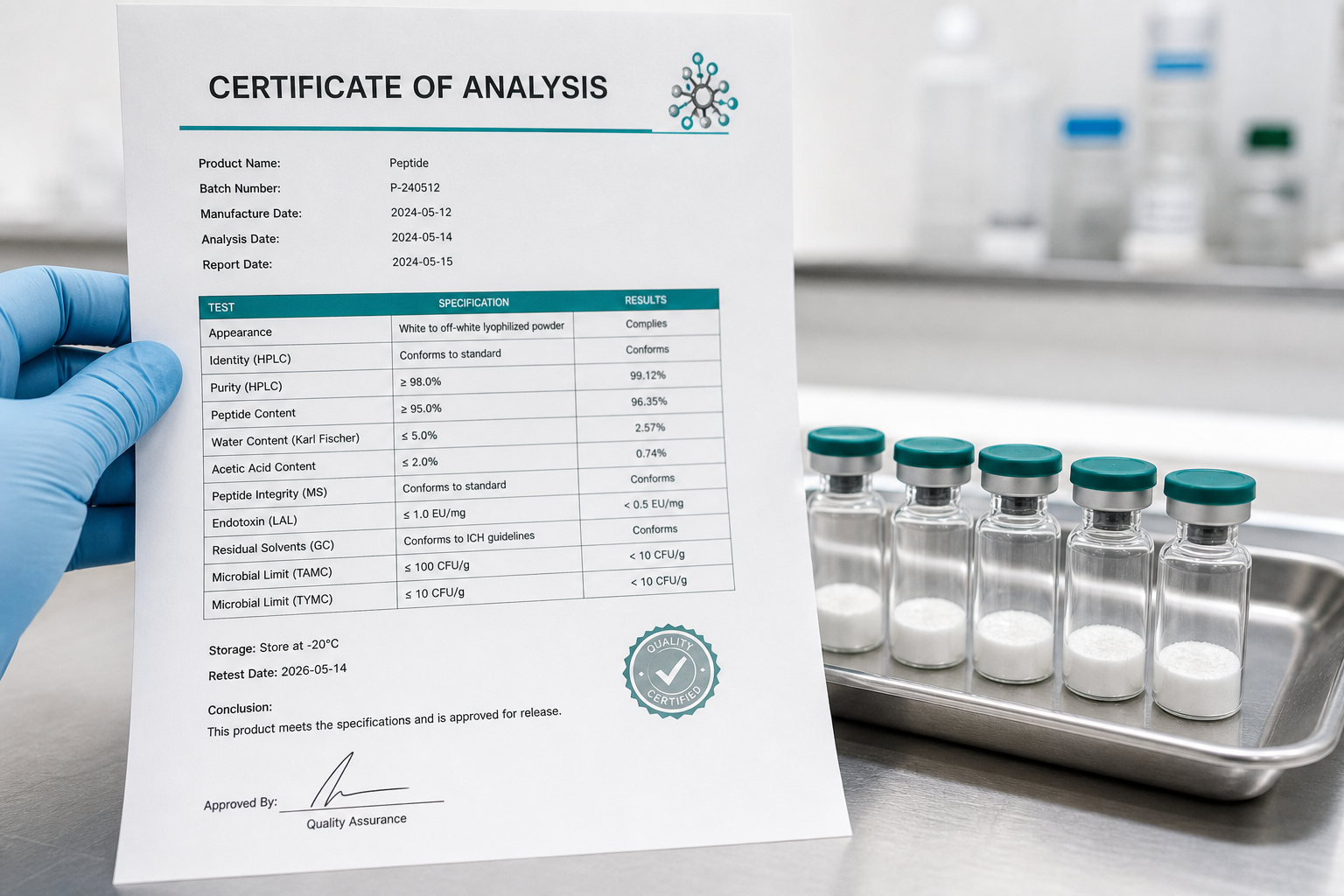
A COA is a structured report of tests performed on a defined sample. Its evidentiary value depends on sample identity and test detail. A generic COA reused across shipments cannot establish lot identity because it does not prove that the tested sample came from the same production batch, filling run, or container population as the purchased material. Matching product names are not enough; lot or batch identifiers must agree across the vial, order record, and report.
The report should also distinguish analytical identity from purity and content. Mass spectrometry can support identity by comparing an observed mass or ion pattern with the expected molecule. Chromatography separates detected components under stated conditions. Neither result, standing alone, establishes the total mass of correctly identified peptide in a vial.
Why 99% HPLC area purity is not 99% vial content
An HPLC area-purity result is usually the target peak area divided by the total integrated peak area detected under that method. USP General Chapter <621> addresses chromatographic procedure concepts, but interpretation still depends on the method, detector, integration settings, reference standard, sample preparation, and system suitability. A reported 99% area result means that the principal detected chromatographic peak accounted for 99% of integrated signal under those conditions.
That ratio does not count substances the detector does not see well or that the sample preparation excludes. Water, acetate or trifluoroacetate counterions, inorganic salts, residual solvents, and some non-UV-active contaminants may add mass without contributing proportionally to the peptide's UV peak. Response factors can differ between the target and impurities. Co-eluting compounds may also appear within one peak. A vial can therefore show high area purity while containing less active peptide mass than the label implies.
Content or assay asks a different question: how much target compound is present relative to a calibrated reference or stated quantity? A strong report labels the result precisely. It should not present area purity as assay, peptide content, net fill mass, or potency. Counterion and water context lets a reviewer understand why gross powder mass and peptide-equivalent mass may differ without assuming substitution or fraud.
A reproducible 12-point COA audit score
Score one point for each item that is present, internally consistent, and readable. Give zero when an item is absent, obscured, contradictory, or cannot be checked. Do not award partial points. The score measures documentation completeness, not proof that a product is suitable for any experiment.
- Lot match: the report lot or batch number exactly matches the received vial or its traceable packaging record.
- Named laboratory: the testing organization has a legal name and enough contact detail to distinguish it from the seller.
- Named method: each result identifies the method or method family, instrument type, and relevant procedure identifier.
- Chromatogram: the report includes a legible chromatogram with axes, retention times, integrated peaks, and sample linkage.
- Mass-spectrometric identity: observed mass data are compared with the expected molecular mass or ion assignments.
- Assay versus area purity: the report states which quantity was measured and does not treat chromatographic area as vial content.
- Counterion and water context: salt form, counterion, moisture, or peptide-basis reporting is stated where it affects mass interpretation.
- Dates: sample receipt, testing, and report dates form a plausible sequence and relate to the lot's release period.
- Authorization: the report contains a reviewer name, signature, controlled approval, or verifiable electronic authorization.
- Independent verification URL: a report ID, QR destination, or laboratory-hosted page permits direct record checking without relying only on a seller-hosted image.
- Relevant contamination tests: endotoxin, microbial, elemental, or residual-solvent results appear when the material and planned laboratory model make them necessary.
- Chain of custody: records identify who selected, sealed, shipped, received, and tested the sample, or describe a controlled process that links those events.
A 12-point record is more reviewable than a four-point record, but the total must not hide a decisive failure. A lot mismatch or broken sample link can defeat the relevance of technically excellent data. Keep the item-level result beside the total so another reviewer can reproduce the decision and see which evidence is missing.

Laboratory competence and method scope
Method suitability is separate from accreditation status. Reviewers should ask whether the method can resolve likely peptide-related impurities, whether identity criteria are defined, whether standards are traceable, and whether system suitability passed. A valid accreditation scope can support confidence in laboratory competence for a listed method, but it cannot repair an unrepresentative sample or a lot-number mismatch.
Contamination testing should follow the research risk
Purity and identity do not answer every contamination question. USP <233> describes procedures for elemental impurity measurement, while USP <85> covers bacterial endotoxin testing. These tests measure different hazards. Passing one cannot be read as evidence for the other, and neither is implied by a clean HPLC trace.
USP <61> addresses microbial enumeration tests, and <62> addresses tests for specified microorganisms. Whether such testing is relevant depends on the material, handling path, container system, and experimental design. The audit question is not whether every COA contains every possible panel. It is whether the documented panel addresses foreseeable interference and contamination risks for the stated laboratory use.
Independent testing still needs chain of custody
Third-party testing reduces one conflict when the laboratory is organizationally separate from the seller, but independence alone does not prove representativeness. If a seller chooses one vial from inventory and submits it without documented controls, the laboratory can accurately report that sample while the connection to the wider lot remains uncertain. Better records identify the sampler, selection method, seal, shipment, receipt condition, report number, and disposition of retained material.
Verification URLs add another control. A laboratory-hosted record lets a reviewer compare the report ID, lot, dates, and results with the seller's copy. Before selecting any material from the research peptide catalog, record the lot shown in the supporting documentation and repeat the check when the received container arrives. Lots change. A report that was relevant to last month's inventory may have no bearing on the current shipment.
Common documentation red flags
Several defects deserve immediate follow-up: cropped chromatograms, missing axes, identical traces attached to different lots, report dates before the stated production date, inconsistent compound names, unresolvable QR codes, absent laboratory identity, or percentages with no method label. Template similarity by itself does not prove fabrication, since laboratories use controlled forms. The concern arises when the underlying sample identifiers, raw-data features, or approval records cannot be reconciled.
Marketing language is not analytical evidence. An RUO statement defines intended research use and should remain consistent with the supplier's conduct, as described in FDA's RUO/IUO guidance. It does not certify purity, sterility, identity, safety, efficacy, or suitability for human or veterinary use. Research peptides discussed here are for laboratory research only and are not for human consumption, diagnosis, treatment, or veterinary use.
A flawless COA on a mismatched lot is worthless. Read the lot number first, every time.
Conclusion
Manufacturing source and analytical verification answer different parts of the same question. Source records describe where and how a lot was made; testing describes selected attributes of the submitted sample. Neither is complete without lot correspondence, suitable methods, readable data, and a traceable custody path.
Use the 12-point audit as a repeatable screen, then examine every zero and every internal contradiction. Give extra weight to lot mismatch, missing identity data, confused assay terminology, and unverifiable reports because those defects break the connection between claim and material. For RUO procurement, a modest claim backed by a checkable record is more useful than an impressive percentage detached from a specific vial.
Frequently Asked Questions (FAQ)
What should a research peptide COA prove? Lot-matched identity confirmed by mass spectrometry, purity shown with a readable HPLC chromatogram, and content reported separately, all tied to a named laboratory and a traceable custody path.
Does 99% HPLC purity mean 99% peptide content? No. That figure is the target peak's share of total detected chromatographic area, not a mass measurement. Water, counterions, and non-UV-active material can add weight without showing up in that percentage.
Does ISO/IEC 17025 accreditation certify a product? No. Accreditation applies to a laboratory and its specific listed methods, not to a seller, a brand, or every test that laboratory happens to offer.
How do I verify a COA before buying? Match the lot number on the certificate to the vial, confirm the test and report dates form a plausible sequence, and look for a chromatogram and mass-spectrometric identity data rather than a bare percentage.
References
- Merrifield RB. (1963). Solid Phase Peptide Synthesis. I. The Synthesis of a Tetrapeptide. Journal of the American Chemical Society
- (2013). Distribution of In Vitro Diagnostic Products Labeled for Research Use Only or Investigational Use Only. U.S. Food and Drug Administration
- (2017). ISO/IEC 17025:2017 General requirements for the competence of testing and calibration laboratories. International Organization for Standardization
- General Chapter <621> Chromatography. United States Pharmacopeia
- General Chapter <233> Elemental Impurities - Procedures. United States Pharmacopeia
- General Chapter <85> Bacterial Endotoxins Test. United States Pharmacopeia
- General Chapter <61> Microbiological Examination of Nonsterile Products: Microbial Enumeration Tests. United States Pharmacopeia
- General Chapter <62> Microbiological Examination of Nonsterile Products: Tests for Specified Microorganisms. United States Pharmacopeia

Editorial Team, Tetrava Labs
Content published by Tetrava Labs is compiled and fact-checked using peer-reviewed scientific literature, HPLC-MS Certificates of Analysis (COA), and primary biochemical data. Research use only.
·
Research Use Only Disclaimer
All products are intended for laboratory research purposes only. Not approved for human consumption, diagnostic use, or therapeutic applications. By purchasing, you confirm you are a qualified research professional.