
AOD-9604 (5mg / 10mg)
$300.00
10 vials · $30.00/vial
100% FREE Shipping on all orders
Buy GLP-1 research peptides for laboratory work on metabolic pathways, appetite signalling, glucose regulation, and neuroprotection. This GLP-1 research catalogue includes semaglutide, tirzepatide, retatrutide, and related incretin compounds at 99%+ HPLC-MS purity with lot-linked COA documentation. Research use only.
$300.00
10 vials · $30.00/vial
$690.00
10 vials · $69.00/vial
$690.00
10 vials · $69.00/vial
$1490.00
10 vials · $149.00/vial
$690.00
10 vials · $69.00/vial
$1790.00
10 vials · $179.00/vial
$330.00
10 vials · $33.00/vial
GLP-1 research peptides are tools for studying incretin signalling. The short answer to "what does research show about GLP-1 drugs?" is that the clinical and preclinical records do not say the same thing in every tissue. In metabolic trials, selective GLP-1 receptor agonists cut mean body weight by roughly 15%. Dual GLP-1/GIP agonists cut it further. Triple agonists that also hit the glucagon receptor have posted still higher Phase 2 means. In the brain, the same receptor class reduces amyloid load and inflammatory markers in rodents, and Phase 3 Alzheimer's programmes are now testing whether that signal survives in people. [1] [2]
This page is for laboratory buyers of GLP-1 research compounds. It covers receptor biology, the three agonist generations you will see in the product grid above, neuroprotection data, the microdosing debate, free tools that actually help bench work, and what to demand on a certificate of analysis before you buy GLP-1 research peptides online.
Glucagon-like peptide-1 is a 30-amino-acid incretin made by intestinal L-cells after a meal. Its receptor, GLP-1R, is a class B G protein-coupled receptor. Early diabetes papers treated it as a beta-cell story. That was incomplete.
GLP-1R is also found in the hypothalamus and brainstem, in cardiac myocytes and vascular endothelium, in proximal tubule cells, in hepatocytes, and in CNS nuclei such as the substantia nigra and cortex. [3] Agonist binding couples mainly to Gαs, raises cAMP, and turns on protein kinase A and Epac2. In beta cells that closes KATP channels, opens calcium channels, and releases insulin only when glucose is high. In hypothalamic neurons the same cascade damps neuropeptide Y signalling. In heart muscle it changes contractile behaviour after ischaemia. In kidney it lowers albuminuria in model systems.
Native GLP-1 lasts under two minutes in vivo. DPP-4 and neutral endopeptidase 24.11 cut it. Research analogues stretch that window with fatty-acid conjugation (liraglutide, about 13 hours) or albumin-binding side chains (semaglutide, roughly a week). Dual and triple agonists fold a second or third receptor into one peptide backbone. [4]
Those side chains matter for lab work. Fatty-acylated GLP-1 research peptides adsorb to plastic more than bare peptides. Labs that tip reconstituted stock into untreated polypropylene tubes often measure a lower free concentration than the nominal dilution implies. Glass or low-bind plastic and a documented stock protocol fix most of that noise.
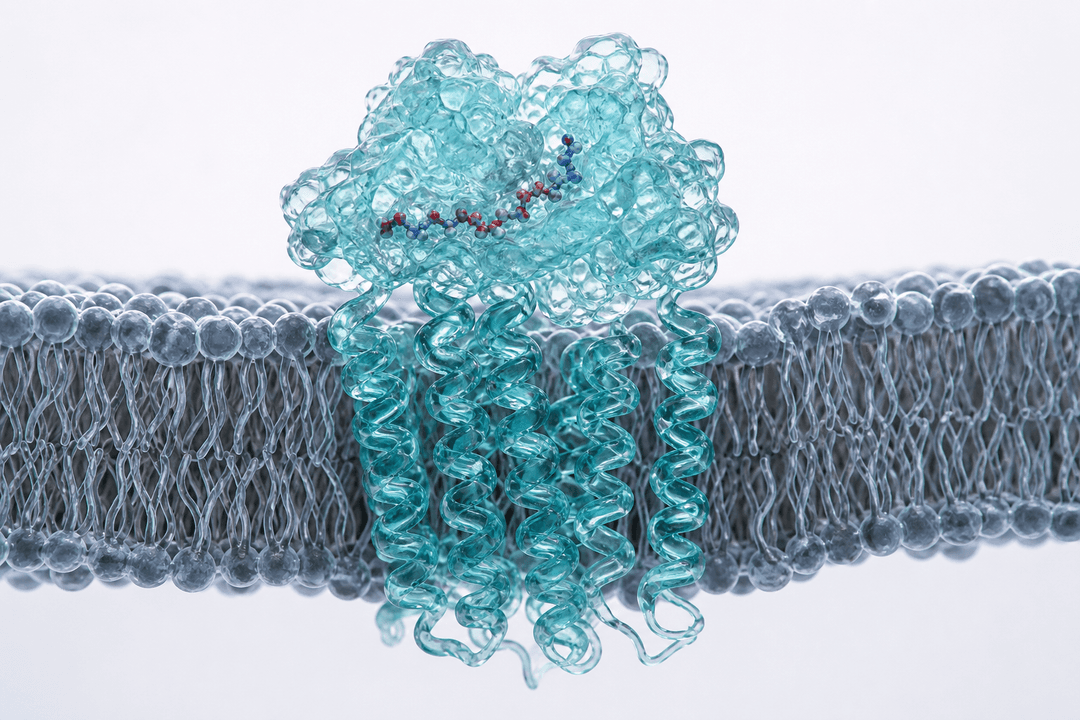
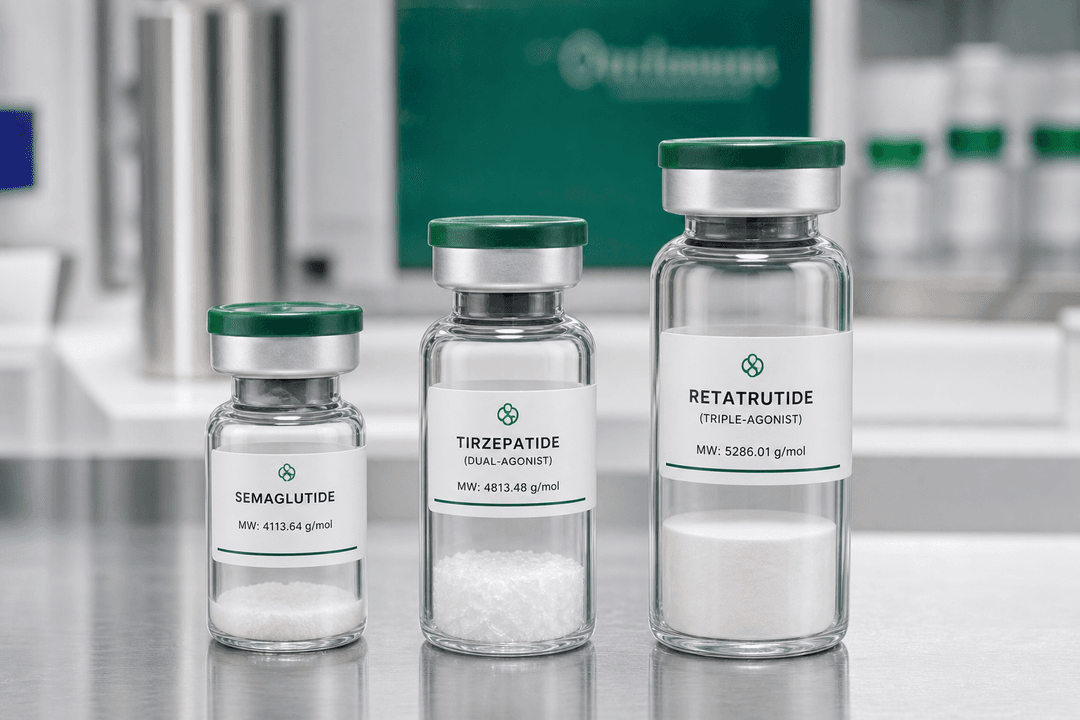
Most GLP-1 research products fall into three agonist classes. Pick the class that matches the receptor question you are asking, not the class with the loudest clinical headline.
Semaglutide is still the reference single-receptor agonist. The STEP programme reported about 14.9% mean weight reduction over 68 weeks in non-diabetic subjects. [1] In rodent models it lowers amyloid-beta deposition, slows neuroinflammation through AMPK, and dampens TLR4/NF-κB signalling. [3] The Phase 3 EVOKE and EVOKE+ trials are testing whether that CNS signal shows up as a cognitive endpoint in early Alzheimer's disease. [2]
Tirzepatide activates GIPR as well as GLP-1R. GIPR activity changes energy expenditure and postprandial insulin release in ways a pure GLP-1 agonist does not. Preclinical work also links dual agonism to cerebral glucose metabolism and neurotrophic factor expression in Alzheimer model rats. [3]
SURMOUNT-1 reported mean weight loss of 22.5% at the highest tirzepatide dose, several percentage points above semaglutide in similar populations. [5] For a GLP-1 research lab that wants the marginal GIPR contribution, the clean design is tirzepatide versus semaglutide in the same assay, same buffer, same readout. That isolates co-operativity without inventing a new endpoint.
Retatrutide adds glucagon receptor agonism. Glucagon raises hepatic glucose output and thermogenesis. In Phase 2 dose-ranging work, retatrutide produced 24.2% mean weight reduction over 48 weeks. [6] Phase 3 packages are still in progress. Retatrutide is investigational. It is sold here as a research compound, not as a drug. For a longer look at liver, kidney, and osteoarthritis readouts beyond weight loss, see retatrutide benefits beyond weight loss.
Pipeline neighbours such as survodutide (GLP-1/glucagon) and cagrilintide plus semaglutide combinations show the same pattern: more receptors, different hepatic and adipose readouts. If your endpoint is hepatic lipid flux, a triple agonist is a different tool from a selective GLP-1R peptide. If your endpoint is GLP-1R-only signalling, start with semaglutide.
CNS expression of GLP-1R was reported in 2002. For years it sat in review footnotes. By 2025–2026 it is a funded neuroscience line, not a metabolic side note. [2]
In APP/PS1 mice, liraglutide cut cerebral amyloid plaque load and improved spatial learning. Semaglutide reduced amyloid deposition and tau hyperphosphorylation in several rodent paradigms. [3] In vitro, GLP-1R agonism lowers microglial activation and cuts IL-1β, TNF-α, and IL-6 release; TLR4/NF-κB is a frequent pathway hit. [7]
Stressed dopaminergic neurons show less ROS, less apoptosis, and better mitochondrial membrane potential under GLP-1R agonists in Parkinson model systems. [7] Type 2 diabetes and Alzheimer's disease share overlapping cerebral insulin signalling failures. FDG-PET work and pathway studies report restored glucose use and more normal PI3K/Akt activity after GLP-1R agonism. [8]
EVOKE is the first large clinical test of that preclinical pile. Until those results land, parallel in-vitro and rodent work with tirzepatide or retatrutide still needs a fixed assay design, a documented stock concentration, and a lot number on every figure. Related metabolic assays also sit in the metabolic and mitochondrial catalogue when the question is energy flux rather than incretin receptor identity.

"Microdosing GLP-1 research" usually means testing concentrations well below the clinical maintenance range. The clinical evidence for that practice in people is thin.
SURMOUNT-1 dose arms for tirzepatide were 5 mg, 10 mg, and 15 mg, with mean weight losses of 15%, 19.5%, and 20.9%. Doubling from 5 mg to 10 mg added 4.5 percentage points. Raising from 10 mg to 15 mg added 1.4. [5] That curve invites low-occupancy hypotheses. It does not prove them.
ClinicalTrials.gov lists NCT07092605 for microdosed GLP-1 work in metabolic endpoints. [9] A November 2025 STAT News review of the clinical literature found no solid randomised evidence that semaglutide or tirzepatide produce clinically meaningful effects at sub-therapeutic doses. [10]
Cell culture is a different problem. cAMP assays, kinase panels, and transcript readouts can be run across a wide concentration range, including levels far below human trial doses. That is legitimate GLP-1 research. It is not a dosing protocol for people, and this catalogue does not supply one.
Search traffic for "best free GLP-1 research tools and calculators" and "top peptide dosage calculators for GLP-1 research" usually wants a human dosing widget. That is the wrong tool class for RUO reagents. What helps at the bench is different.
Named-entity searches such as "professor peptides GLP-1 research compounds" or "Rebecca Diamond GLP-1 research" often land on third-party blogs or other sellers. Treat those as navigation noise. Match your order to compound identity, HPLC-MS data, and a lot number instead. The Research Hub is the place for longer compound write-ups on this site.
Keep lyophilized GLP-1 research peptides at -20°C, dry, and dark until you open the vial. Once reconstituted under your lab SOP, aliquot. Avoid repeated freeze-thaw. Fatty-acylated analogues (semaglutide, tirzepatide, retatrutide) are more prone to surface loss and aggregation than short linear peptides, so document solvent, concentration, and hold time on every aliquot label. Cold-chain packaging details are on the shipping page. Diluents and related lab reagents live under lab supplies.
Do not treat a "dosage calculator" screenshot as a stability study. If you need working-concentration guidance, derive it from your assay's EC50 literature and your own titration curve.
Semaglutide is a 31-residue peptide with a C-18 fatty diacid on a linker. Tirzepatide is a 39-amino-acid dual agonist. Retatrutide adds a C-20 fatty diacid to a 39-residue backbone. A UV absorbance number alone will not catch a truncated sequence, a missing side chain, or an aggregate that still looks "pure" on a crude chromatogram.
Ask for an HPLC purity trace at the lot level (aim for ≥99% area under curve), mass spectrometry identity within a few ppm of the theoretical mass, and a COA tied to the vial you receive, not a stock PDF from another run. Prefer lyophilized powder over pre-dissolved liquid for shelf life.
Tetrava ships GLP-1 research peptides lyophilized with lot-linked COA files that include HPLC-MS data. Read the batch record before you lock an experimental design.
If the query is "GLP-1 research peptides where to buy" or "where to buy online," the useful filter is documentation, not a discount code. Confirm the compound name and strength match your protocol, open the COA for that lot, check cold-chain shipping, and keep the order for research use only.
This catalogue lists GLP-1 research peptides for sale as RUO reagents. They are not for human consumption, diagnosis, or therapy. Start with semaglutide, tirzepatide, or retatrutide, then cross-check purity in the COA Library.
All compounds are for research use only (RUO). Not for human consumption, diagnosis, or therapy. Semaglutide, tirzepatide, and retatrutide ship lyophilized with lot-linked HPLC-MS documentation and cold-chain packaging.
References