Lab reviews
Customer reviews
5.0 · 1
Northridge Assay Group
Aug 14, 2026
Lot matched the COA on arrival. HPLC identity and purity notes were easy to file against our ELN. Cold-chain packaging held up. We will reorder the 10 mg vial for the next assay run
Semaglutide (5mg)
For Research Use Only. Not for human consumption.
99%+ purity
5.0(1 review)$89.00 – $690.00
Buy Semaglutide online from Tetrava Labs. Semaglutide is a long-acting GLP-1 receptor agonist and a reference compound in incretin, appetite, and glycemic pathway research.
- FREE shipping on all orders
- Guaranteed delivery to your doorstep
- Secure payment with card or crypto
- Enjoy discounts with every purchase
24/7 support — Email or WhatsApp
Select strength
1 / 5 / 10 vials
$690.00
$890.00
10 vials · $69.00/vial
You save $200
What is Semaglutide?
Semaglutide is a GLP-1 receptor agonist. Novo Nordisk started from native human GLP-1, which DPP-4 chews through in a couple of minutes, and changed two places on the chain. Position 2 got aminoisobutyric acid (Aib) in place of alanine, which blocks that cleavage. Lysine 26 got a C18 fatty diacid hung off an AEEA-AEEA-γ-Glu spacer, so the peptide can bind albumin in blood and stay in circulation for about a week instead of a few minutes.[1]
Ozempic, Wegovy, and Rybelsus are the FDA-approved brand names for type 2 diabetes and chronic weight management. Tetrava Labs does not sell those products. This page lists a sterile, lyophilized semaglutide reagent for GLP-1 receptor research: binding assays, cAMP readouts, glucose-handling models, and head-to-head work against other incretin peptides. The identity fields in the Specifications tab match CAS 910463-68-2, formula C187H291N45O59, molecular weight 4113.58. Every lot ships with third-party HPLC identity and purity data. Research use only. Not for human or veterinary use.
Semaglutide Peptide Research
How semaglutide is built, and how it works
Native GLP-1 is a terrible drug candidate for one boring reason: DPP-4 cuts it almost as soon as it is released. The Aib swap at position 2 takes that cut site away. The fatty diacid is a different trick. Bound to albumin, the peptide clears more slowly through the kidney, so a low concentration hangs around for days.[1]
At the GLP-1 receptor, semaglutide slows gastric emptying and drives glucose-dependent insulin release from the pancreas. It also acts on hypothalamic circuits that cut food intake. Glucose-dependent is the part that matters. The insulin-release effect drops off as blood glucose comes back down, unlike older diabetes drugs that force insulin release no matter what glucose is doing.
In a lab that is the whole reason to keep a GLP-1-only agonist on the shelf. If the protocol is asking what GLP-1 receptor activity does on its own, semaglutide is the reference. Dual and triple agonists belong in a different arm.
The weight-loss data: what STEP 1 actually measured
STEP 1 is the trial behind most "semaglutide weight loss" numbers. 1,961 adults with obesity, or overweight plus a weight-related condition, none of them diabetic, 68 weeks, placebo-controlled.[2] Semaglutide 2.4 mg weekly produced a mean body-weight change of -14.9%, versus -2.4% on placebo. Absolute change was -15.3 kg versus -2.6 kg.
The responder cuts are less quoted and more useful. 86.4% of the semaglutide group lost 5% or more of body weight, versus 31.5% on placebo. 69.1% lost 10% or more, versus 12.0%. Half of the semaglutide group, 50.5%, lost 15% or more, versus 4.9% on placebo.[2]
It was not fast. Investigators used a slow dose-escalation schedule because gastrointestinal events cluster when the dose jumps. At week 68 the mean curve was still going down. "How long does it take for semaglutide to work" has a blunt answer in this paper: the trial ran well over a year and the effect was still building.
Gastrointestinal events, mainly nausea and diarrhea, showed up in 74.2% of the semaglutide group versus 47.9% on placebo. Most were mild to moderate and sat around dose increases. 7.0% quit because of adverse events, versus 3.1% on placebo.[2] Gallstones were less common but still higher: cholelithiasis in 1.8% versus 0.6%. Acute pancreatitis was rare, 3 people (0.2%) versus none on placebo. Those figures come from a supervised trial of an approved product. They are not a safety label for a research vial.
Semaglutide and cardiovascular risk: the SELECT trial
Weight loss and cardiovascular risk are separate questions. SELECT enrolled 17,604 adults with established cardiovascular disease and overweight or obesity, no diabetes, and followed them for a mean of 39.8 months.[3]
A primary endpoint event, cardiovascular death, non-fatal heart attack, or non-fatal stroke, happened in 569 of 8,803 people on semaglutide 2.4 mg (6.5%) and 701 of 8,801 on placebo (8.0%). Hazard ratio 0.80. Permanent discontinuation because of adverse events ran 16.6% versus 8.2%.
That result is why the approved label, for a defined population, includes cardiovascular risk reduction. It does not travel with Tetrava's catalog item. This page sells a laboratory reagent.
Oral semaglutide: why a peptide needs a tablet trick
A peptide this size usually dies in the stomach. Enzymes and low pH take the backbone apart before much of it can cross. Rybelsus, the oral tablet, puts semaglutide in the same tablet as SNAC, sodium N-(8-[2-hydroxybenzoyl] amino) caprylate.[4]
SNAC works next to the tablet, not throughout the body. It briefly raises the pH at the tablet surface so pepsin has a harder time chewing the peptide, and it loosens the nearby gastric epithelial membrane just enough for semaglutide to cross through the cells, transcellularly, without opening tight junctions.[4] The window is small and local. Food or extra water dilutes the SNAC concentration at that patch of stomach lining, which is why the approved tablet is taken on an empty stomach with a sip of water.
That constraint belongs to Rybelsus. Tetrava does not sell semaglutide pills, oral semaglutide, or a SNAC co-formulation. The listing here is a lyophilized vial.
Ozempic, Wegovy, Rybelsus: one molecule, three products
Yes, Ozempic is semaglutide. Wegovy is too. Rybelsus is the oral one. Same active molecule, different products. Ozempic is the type 2 diabetes injection, labeled up to 2 mg weekly. Wegovy is the chronic weight-management injection, labeled up to 2.4 mg weekly. Rybelsus is the SNAC tablet, approved for type 2 diabetes.
"Semaglutide vs Ozempic" is usually a naming mix-up, not a pharmacology mix-up. The brand names differ in dose, delivery, and the population each was studied in. Tetrava Labs lists none of them. No pen. No prescription. No patient label.
What this catalog listing actually is
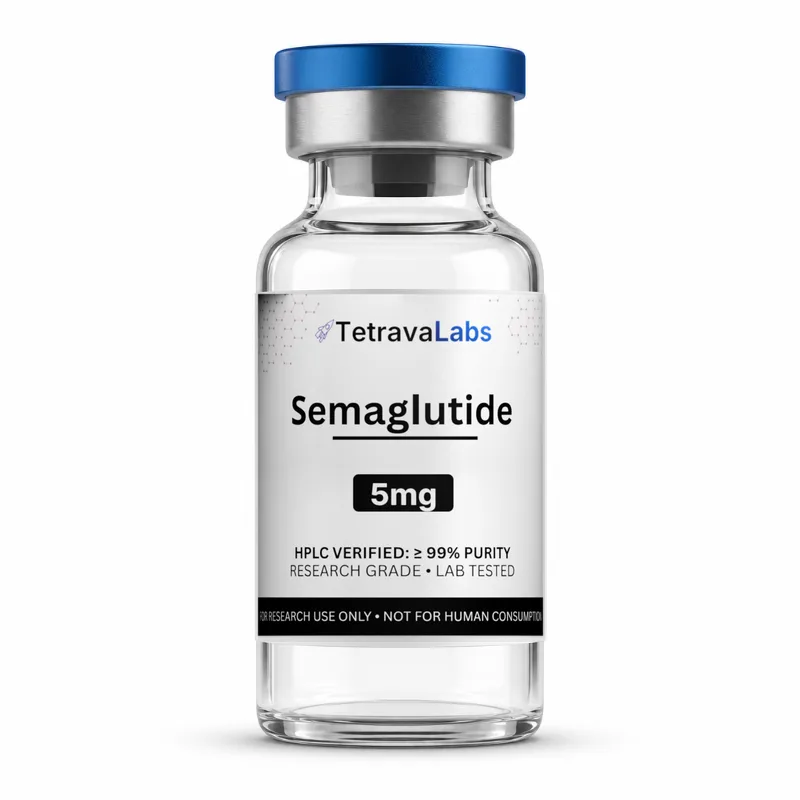
The vial on this page is lyophilized semaglutide in 5 mg and 10 mg research strengths. It is not a finished injection, not a milligram-per-milliliter solution, and not a tablet. A reconstituted research prep is a lab variable you set in the SOP. It is not interchangeable with Ozempic, Wegovy, or Rybelsus.
Labs that buy semaglutide peptides here usually want a documented GLP-1-only comparator. Common pairings: tirzepatide when the study needs dual GIP/GLP-1 activity, retatrutide when glucagon-receptor activity is in the protocol too, and the cagrilintide + semaglutide blend when the question is amylin-plus-GLP-1 rather than GLP-1 alone.
Identity check is boring and non-negotiable. CAS 910463-68-2 on the paperwork should match the vial. Lot number on the vial should match the lot number on the Certificate of Analysis. A purity percentage with no lot-linked HPLC-MS record is a catalog claim, not a result.
Semaglutide vs tirzepatide
Semaglutide hits GLP-1. Tirzepatide hits GIP and GLP-1. That is the difference. Searches for "tirzepatide vs semaglutide" and "is tirzepatide better than semaglutide" are usually asking which molecule lost more weight in a trial, which is a different question from which receptor profile a protocol needs.
SURMOUNT-5 ran approved tirzepatide against approved semaglutide in the same obesity protocol, so it is the comparison that does not rest on cross-trial arithmetic.[5] Tirzepatide produced a larger drop in body weight and waist circumference over that window, at those doses, in that population. It does not make tirzepatide the right reagent for every assay. Write the receptor question into the protocol first, then pick the vial.
Compounded semaglutide: what the FDA has actually said
Compounded semaglutide is a pharmacy-prepared product made outside Novo Nordisk's approved manufacturing. A lot of it showed up during the 2022-2024 Ozempic and Wegovy shortage, when compounding copies of a shortage drug is allowed under narrow conditions.
FDA drew a line on the salt forms. Ozempic and Wegovy contain semaglutide base. Some compounders used semaglutide sodium or semaglutide acetate instead. In an April 2023 letter to the National Association of Boards of Pharmacy, FDA's Office of Compounding Quality and Compliance wrote that it was "not aware of any basis for compounding a drug using these semaglutide salts that would meet federal law requirements."[6] A public adverse-event warning followed in May 2023. Semaglutide has never been on FDA's 503A bulk-compounding list.
"Does compounded semaglutide work" still does not have a published pharmacokinetics answer for the salt forms the way the base compound does. A compounded product, an approved pen, and Tetrava's RUO vial are three different categories. This page is the third one.
Reported safety signals: thyroid tumors, hair loss, and what the label actually says
The FDA label carries a boxed warning for thyroid C-cell tumors. The finding is from rats and mice. The label says human relevance "has not been determined."[7] Anyone with a personal or family history of medullary thyroid carcinoma, or with MEN 2, is contraindicated. "Does semaglutide cause cancer" does not have a clean human yes or no. What exists is an animal finding, a boxed warning, and a contraindication.
Alopecia showed up in STEP 1: 3.3% on semaglutide versus 1.0% on placebo, 4.0% of women and 0.9% of men.[2] The pattern that fits is telogen effluvium, a temporary shed after rapid weight loss, which tends to ease once weight stabilizes. Fatigue is not a main signal in those trial tables the way nausea and diarrhea are. "Does semaglutide make you tired" does not have a strong trial number behind it either way.
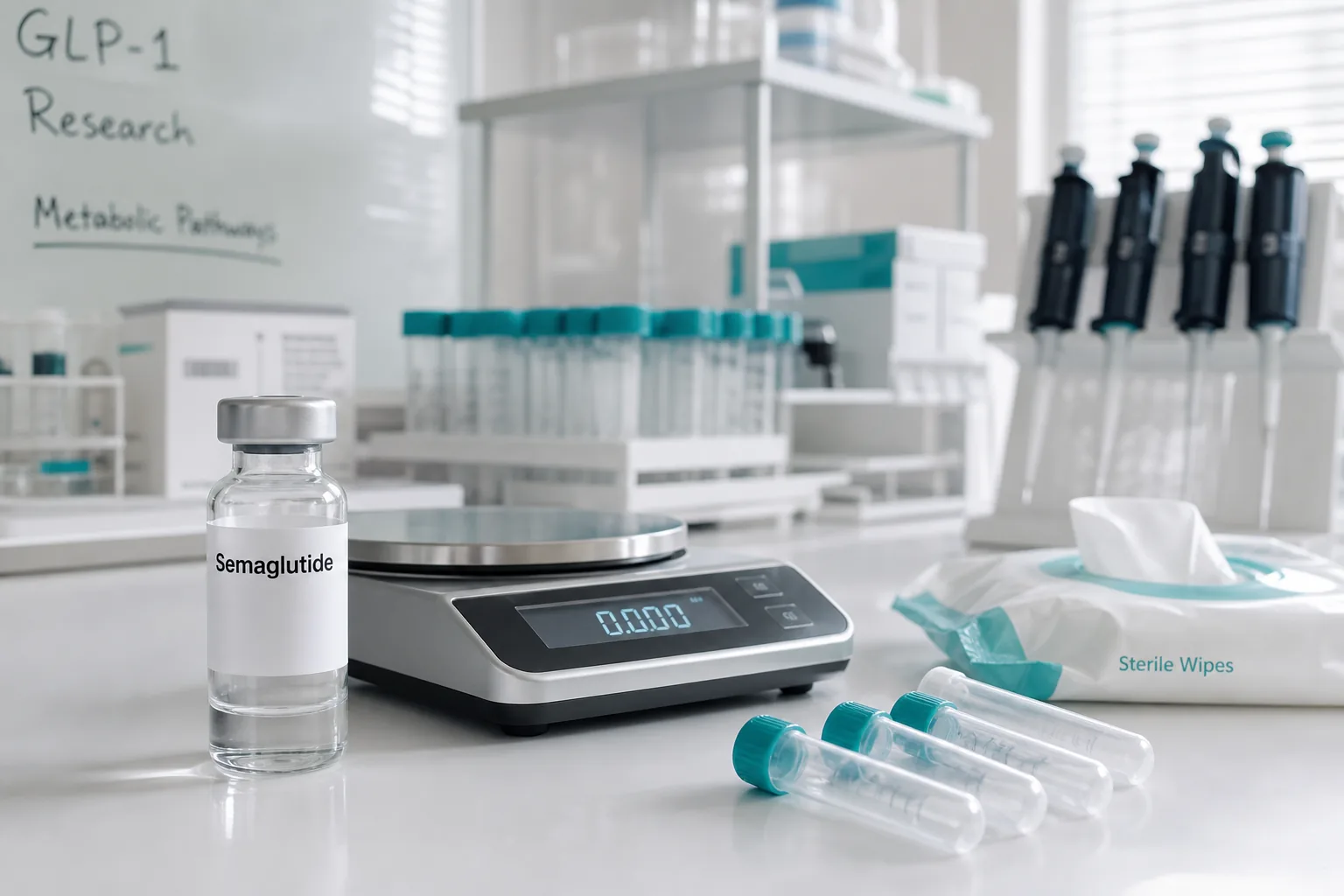
Laboratory handling: reconstitution, storage, and documentation
Tetrava ships semaglutide lyophilized. Store sealed vials at -20°C. Skip repeated freeze-thaw. Reconstitute under sterile technique with the diluent your SOP names, right before use.
Hold the working solution the way the method says, then log diluent lot, concentration, date, and operator in the ELN so the prep still matches the batch Certificate of Analysis a month later. This page does not publish a unit-to-milligram conversion, a starting dose, an injection site, or a weight-loss dosage chart. Those questions belong to an approved label and a clinician. They do not belong on a Research Use Only catalog page.
References & Citations
- Lau J, Bloch P, Schäffer L, et al. Discovery of the once-weekly glucagon-like peptide-1 (GLP-1) analogue semaglutide. J Med Chem. 2015;58(18):7370-7380.
- Wilding JPH, Batterham RL, Calanna S, et al. Once-weekly semaglutide in adults with overweight or obesity (STEP 1). N Engl J Med. 2021;384(11):989-1002.
- Lincoff AM, Brown-Frandsen K, Colhoun HM, et al. Semaglutide and cardiovascular outcomes in obesity without diabetes (SELECT). N Engl J Med. 2023;389(24):2221-2232.
- Buckley ST, Bækdal TA, Vegge A, et al. Transcellular stomach absorption of a derivatized glucagon-like peptide-1 receptor agonist. Sci Transl Med. 2018;10(467):eaar7047.
- Aronne LJ, Horn DB, le Roux CW, et al. Tirzepatide as compared with semaglutide for the treatment of obesity (SURMOUNT-5). N Engl J Med. 2025;393(1):26-36.
- U.S. Food and Drug Administration, Office of Compounding Quality and Compliance. Letter to the National Association of Boards of Pharmacy regarding semaglutide salt forms. April 27, 2023.
- U.S. Food and Drug Administration. Ozempic and Rybelsus (semaglutide) prescribing information: Boxed Warning, thyroid C-cell tumors.
Author Profile

Tetrava Labs Editorial Team
Editorial Team, Tetrava Labs
Content published by Tetrava Labs is compiled and fact-checked using peer-reviewed scientific literature, HPLC-MS Certificates of Analysis (COA), and primary biochemical data. Research use only.
Frequently Asked Questions
Research Use Only Disclaimer
All products are intended for laboratory research purposes only. Not approved for human consumption, diagnostic use, or therapeutic applications. By purchasing, you confirm you are a qualified research professional.