
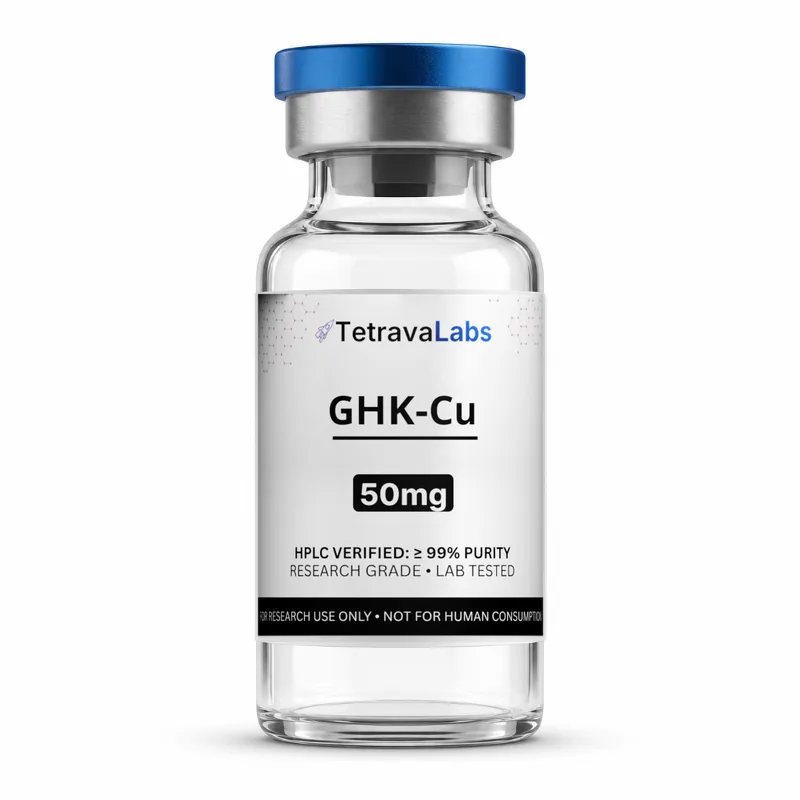
GHK-Cu (50mg)
For Research Use Only. Not for human consumption.
99%+ purity
$35.00 – $280.00
Buy GHK-Cu online from Tetrava Labs. GHK-Cu is a copper-binding tripeptide extensively studied in skin remodeling, wound healing, and gene-expression research.
- FREE shipping on all orders
- Guaranteed delivery to your doorstep
- Secure payment with card or crypto
- Enjoy discounts with every purchase
24/7 support — Email or WhatsApp
Select strength
1 / 5 / 10 vials
$280.00
$350.00
10 vials · $28.00/vial
You save $70
GHK-Cu Peptide
GHK-Cu is glycyl-L-histidyl-L-lysine bound to copper(II). Pickart's 1980 Nature paper treated the plasma tripeptide as a copper-uptake factor, not as a cream ingredient.[4]
Tetrava Labs sells GHK-Cu as a lyophilized Research Use Only solid for copper-handling and extracellular-matrix work. A buy GHK-Cu order on this catalog is a documented vial among the other research peptides, not a serum. Not for human or veterinary use.
Specifications
These fields are the catalog identity for GHK-Cu. Match the lot on the vial to the COA library published by Tetrava Labs before an assay. CAS 89030-95-5 is the registry lookup on PubChem.
GHK-Cu Research
Mechanism
The 1980 Nature experiment asked whether the plasma tripeptide moves copper into cells.[4] No serum. No volunteer arm.
If the assay is copper uptake or a copper-dependent enzyme, copper-free GHK and GHK-Cu are different reagents. Putting both in the same well because the three-letter name matches is a methods error. Later reviews keep the metal-handling idea and add gene-level remodeling.[2][3] Write the form that went into the well. The line "copper peptide" is not an identity.
What the published models measured
The peptide is Gly-His-Lys. The catalog hyphen marks copper(II). That distinction matters the moment the readout is copper delivery rather than the backbone alone.[3][4]
Pickart's later reviews put GHK-Cu against extracellular-matrix genes and remodeling enzymes in cultured cells and tissue models.[2] Those papers describe plates and explants. They do not describe a finished topical sitting on a bathroom shelf.
A widely copied sentence says GHK resets expression of thousands of genes. The 2018 gene-data paper is a microarray-style argument. It is not a head-to-head of a cosmetic GHK-Cu peptide topical against a lyophilized research lot.[1]
A differential-expression list is a hypothesis generator. It does not prove two products that share three letters are interchangeable. In uptake work that treats copper delivery as the mechanism, GHK and GHK-Cu still split.[4]
"Is GHK-Cu peptide safe" is a lab SOP question: identity, lot HPLC, chemical-hygiene rules. Plasma occurrence does not turn an RUO vial into personal care.[2][3]
Seed dermal fibroblasts with GHK-Cu and score a published matrix endpoint such as collagen or glycosaminoglycan.[2] A 24-hour ELISA can look flat. The same wells at 72 hours can look like another study. Those reviews treat matrix remodeling as a delayed transcriptional program, not an overnight dye change.[2]
Add a copper-uptake arm copied from the 1980 cellular work.[4] If GHK and GHK-Cu overlay on the ELISA and split on the metal assay, the hyphen earned its keep.
Capsule and topical listings online are usually finished consumer formats. A cell monolayer does not answer capsule absorption. A topical vehicle is a formulation study. This page is the research solid. Tetrava lists 50 mg and 100 mg lyophilized vials.
Labs file GHK-Cu next to other tissue-repair reagents. GHK-Cu is a copper-binding tripeptide. Material sold as TB-500 is an acetylated heptapeptide fragment of thymosin beta-4.[3]
Need an actin-binding fragment? Order that fragment. Need a copper-tripeptide complex? Order GHK-Cu.
Pickart's tissue-remodeling review treats GHK as a circulating tripeptide whose measured plasma level falls with age in the human data that paper cites.[3] That is a plasma-chemistry observation. It is not a reason to treat a lyophilized research lot as a replacement for endogenous GHK-Cu.
Where the evidence stops
Research-use-only material is not a prescription, a compounded drug, or a personal-use protocol. A paper or an approved label describes its own method. It does not describe this vial.
Identity and the certificate of analysis
Searches for ghk-cu peptide where to buy and ghk-cu peptide price usually want a cart number first. The number that matters is the lot on the vial against the HPLC identity on the Certificate of Analysis.
If the label, sequence, and chromatogram disagree, leave the plate empty.
Keep sealed lyophilized vials under the copper-peptide storage line your SOP already names. Log lot, operator, and COA file in the ELN.
References
- Pickart L, Margolina A. Regenerative and protective actions of the GHK-Cu peptide in the light of the new gene data. Int J Mol Sci. 2018;19(7):1987.
- Pickart L, Vasquez-Soltero JM, Margolina A. GHK peptide as a natural modulator of multiple cellular pathways in skin regeneration. Biomed Res Int. 2015;2015:648108.
- Pickart L. The human tri-peptide GHK and tissue remodeling. J Biomater Sci Polym Ed. 2008;19(8):969-988.
- Pickart L, Freedman JH, Loker WJ, et al. Growth-modulating plasma tripeptide may function by facilitating copper uptake into cells. Nature. 1980;288:715-717.
Author Profile

Tetrava Labs Editorial Team
Editorial Team, Tetrava Labs
Content published by Tetrava Labs is compiled and fact-checked using peer-reviewed scientific literature, HPLC-MS Certificates of Analysis (COA), and primary biochemical data. Research use only.
Frequently Asked Questions
Research Use Only Disclaimer
All products are intended for laboratory research purposes only. Not approved for human consumption, diagnostic use, or therapeutic applications. By purchasing, you confirm you are a qualified research professional.
You may also like
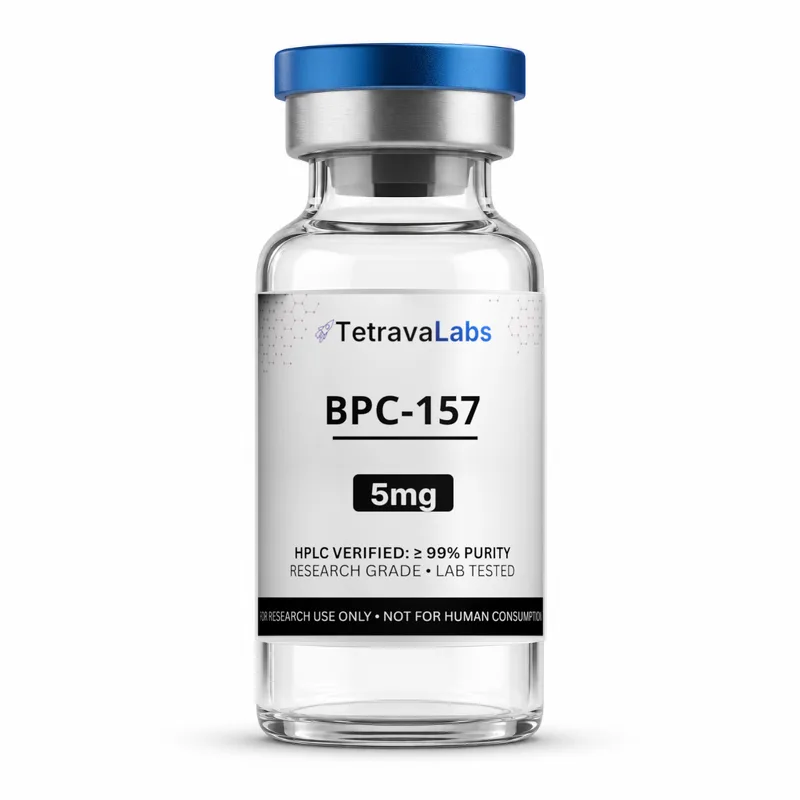
BPC-157
From$49.00
5mg / 10mg · 1, 5 or 10 vials
As low as $39.20/vial
For laboratory research use only
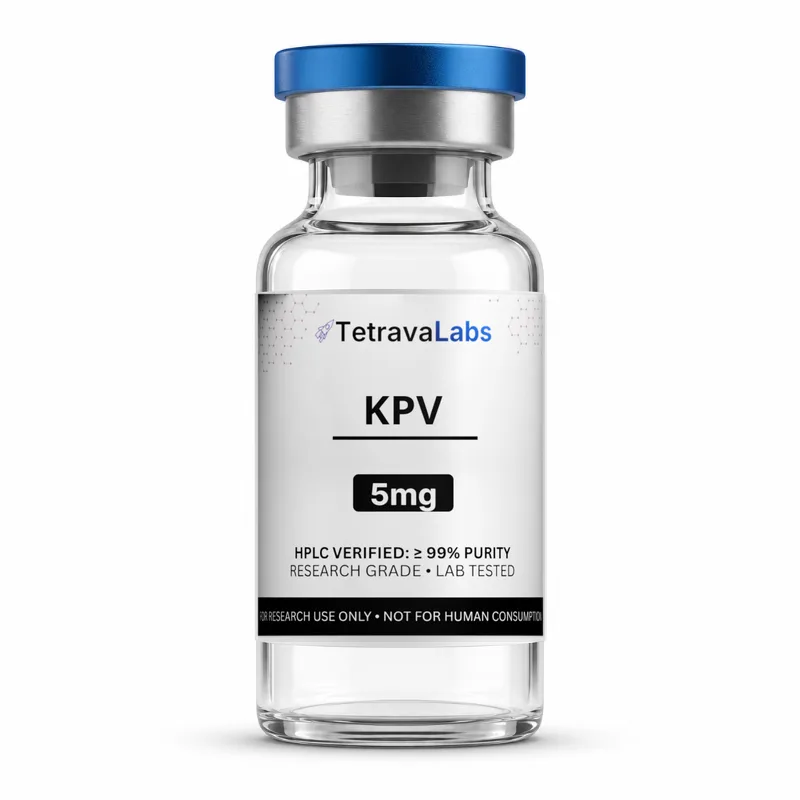
KPV
From$35.00
5mg / 10mg · 1, 5 or 10 vials
As low as $28.00/vial
For laboratory research use only
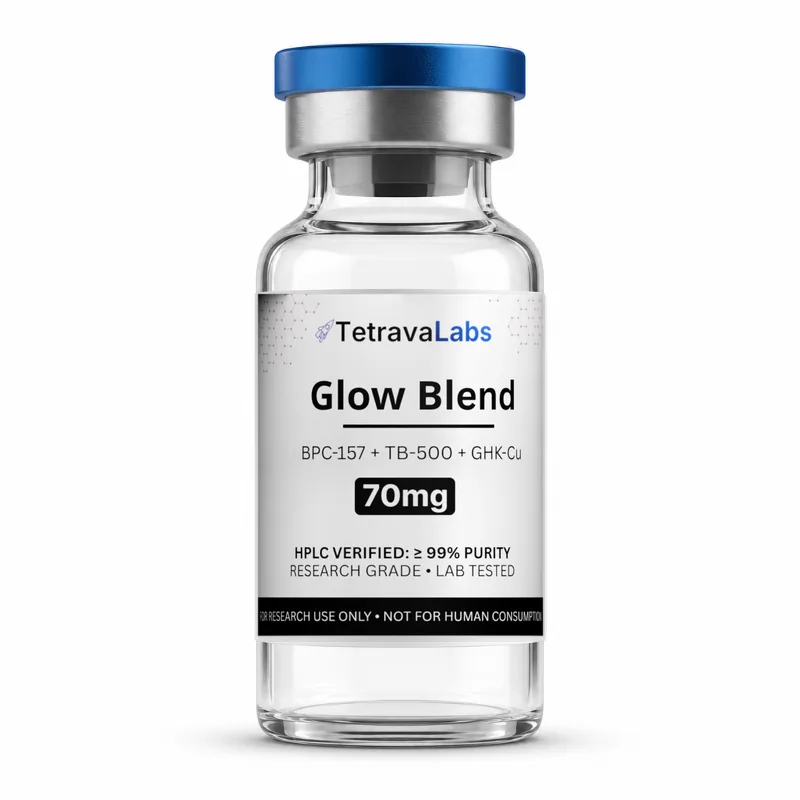 Blend
Glow
BPC-157 + TB-500 + GHK-Cu
From$89.00
30mg – 85mg · 1, 5 or 10 vials
As low as $71.20/vial
For laboratory research use only