
Where to Buy NAD+ in 2026: A Guide to the Best Sources for Cellular Energy and Longevity
Tetrava Labs Editorial Team9 min read
NAD+, NMN, and NR get marketed as one interchangeable category, but they're pharmacologically distinct with different evidence bases. Here's how to identify which one a listing is actually selling before comparing suppliers.
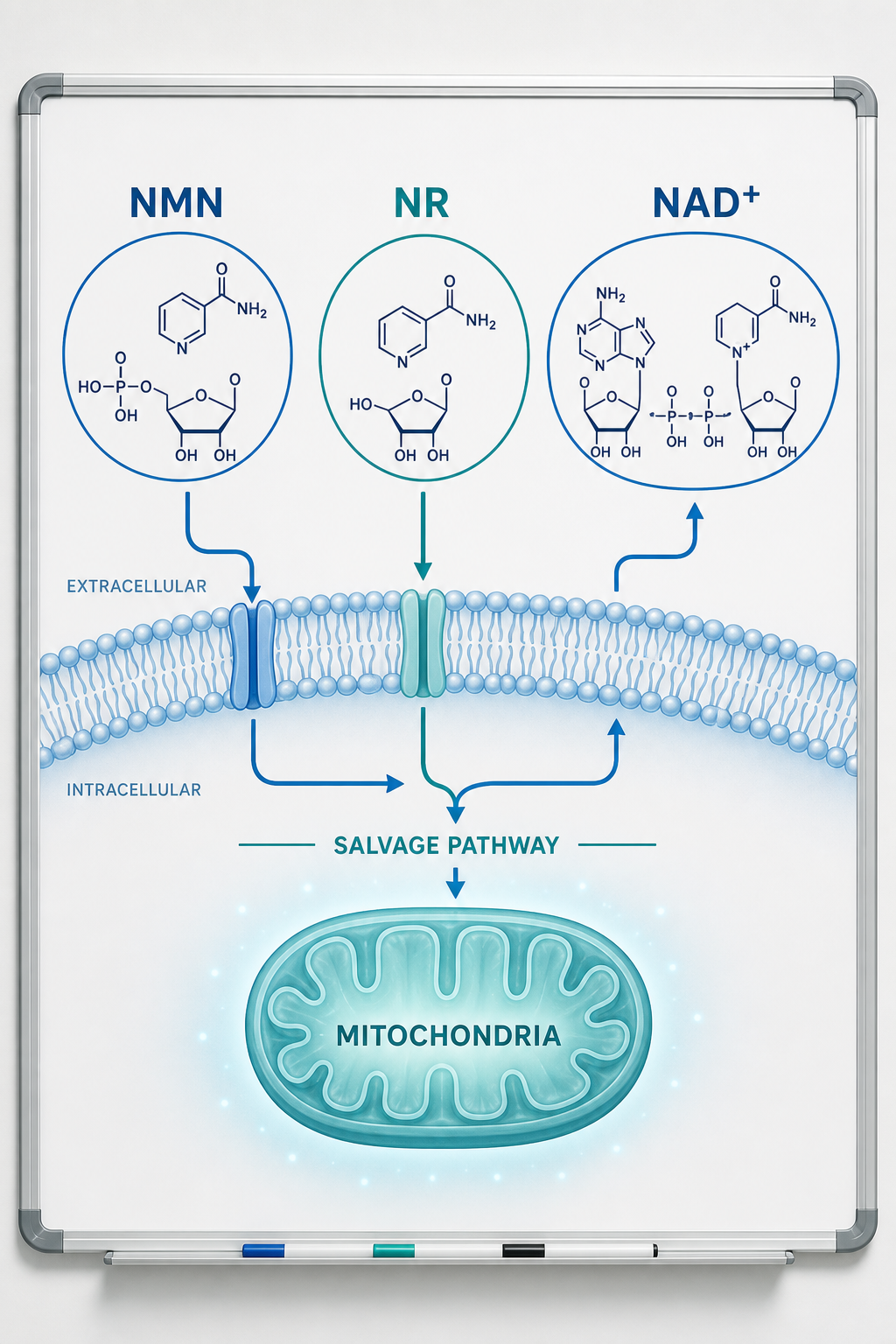
Where to buy NAD+ in 2026 is a three-molecule problem before it is a supplier problem. NAD+ sits at the center of one of the more misunderstood product categories in the research-compound market, and the confusion starts with a basic pharmacology fact most listings skip entirely: intact NAD+ has essentially no oral bioavailability and breaks down before it can cross into most cells intact. That's why the actual research and commercial landscape around "boosting NAD+" runs mostly through precursor molecules, nicotinamide mononucleotide (NMN) and nicotinamide riboside (NR), which are cell-permeable and get converted to NAD+ intracellularly through the salvage pathway. Injectable NAD+ itself is a separate, IV-administered category with a much thinner human evidence base than its precursors. Sourcing "NAD+" without understanding which of these three you're actually looking at is the single most common mistake in this category, and it's worth sorting out before comparing suppliers.
NAD+ decline with age is well established; what to do about it is still being worked out
NAD+ is a coenzyme central to cellular energy metabolism and a required substrate for sirtuins, a family of proteins linked to DNA repair and metabolic regulation. Its cellular concentration is well documented to decline with age, a relationship reviewed in detail by Imai and Guarente in a widely cited mechanistic overview. That decline is real and measured. Where the evidence gets thinner is the second half of the story: whether restoring NAD+ levels in humans, rather than in mice, produces the metabolic benefits seen in animal models. A 2018 randomized, double-blind crossover trial published in Nature Communications found that nicotinamide riboside supplementation reliably raised blood NAD+ metabolome levels in healthy middle-aged and older adults and was well tolerated. That's a meaningful, specific finding. But raising the metabolite isn't the same claim as reversing an aging-related outcome, and the trial was designed to test tolerability and pharmacokinetics, not long-term functional endpoints.
NMN, NR, and injectable NAD+ are not interchangeable research tools
NMN and NR are both precursor compounds the body converts into NAD+ through the same enzymatic salvage pathway, and both are small enough to cross cell membranes. That's why oral supplementation with either has shown measurable increases in blood NAD+ metabolites in controlled human trials. Injectable NAD+ bypasses the absorption question entirely by delivering the coenzyme directly into the bloodstream, the basis for its long-running but comparatively small-scale use in IV-therapy settings, mostly outside the peer-reviewed clinical-trial literature. A 2023 review in the Journals of Gerontology summarizing human dosing data across all three compound types is useful precisely because it treats them as pharmacologically distinct rather than one interchangeable "NAD+ boost" category, which is exactly how most retail marketing treats them.
Why injectable NAD+ has a decades-long history that predates its modern trial evidence
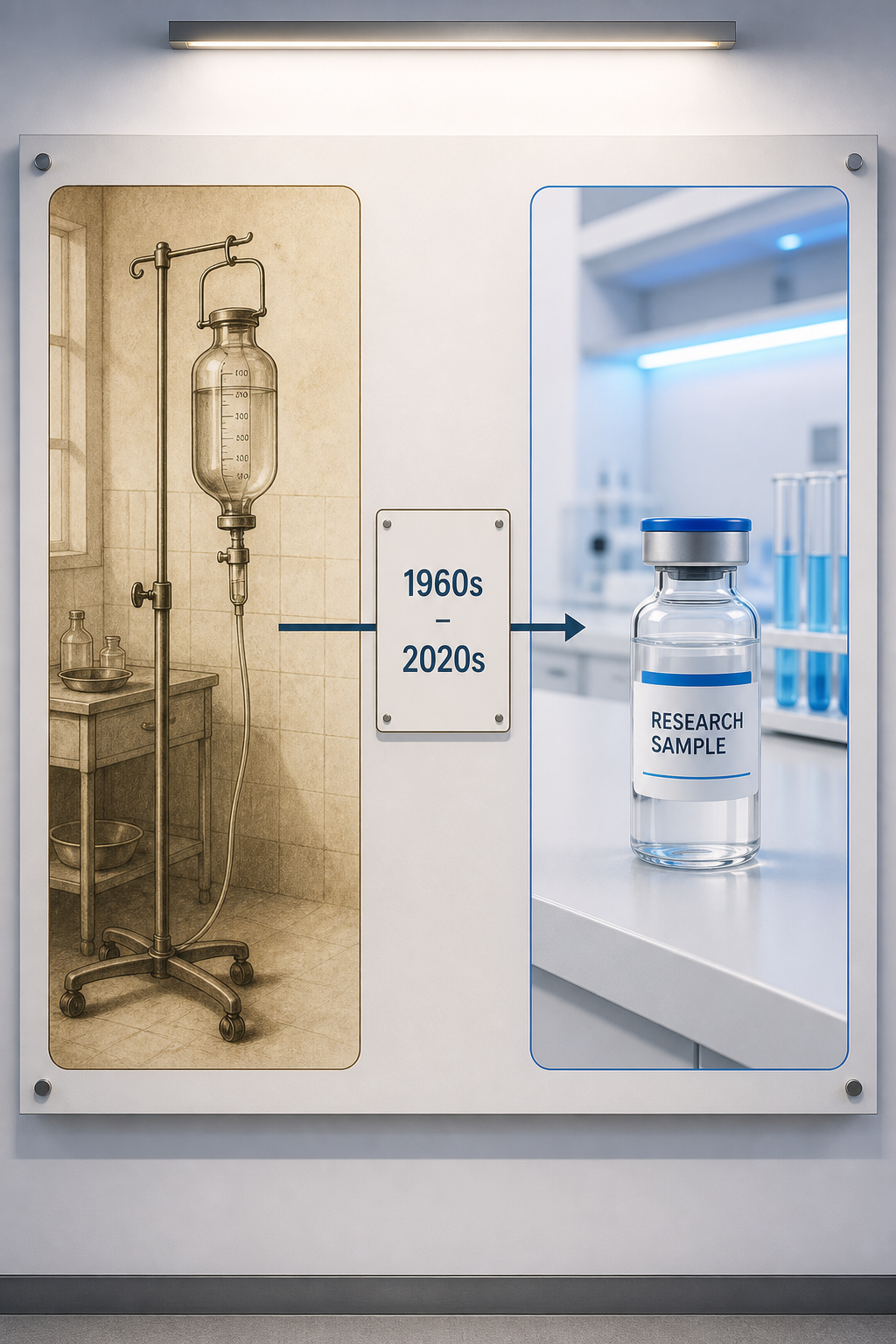
Intravenous NAD+ administration isn't a recent development riding the current longevity trend. It dates back to 1961, when physician Paul O'Hollaren first described using NAD+ infusions to treat withdrawal symptoms across more than 100 cases of alcohol and substance dependence, an origin still cited in the addiction-medicine literature today. That six-decade clinical-use history is real, but it's worth separating from the modern longevity-market framing built on top of it. Most of the original addiction-withdrawal work predates the randomized-controlled-trial standard used in current pharmacology research. A 2025 Guardian investigation into UK NAD+ clinics quoted addiction researchers noting that much of the therapeutic claim base still traces back to that same small, decades-old participant pool rather than to newer, larger trials. None of that makes injectable NAD+ research uninteresting. It makes the specific claim in any given piece of marketing worth checking against which era of evidence it's actually drawing from.
The NAD+ research-supplier landscape, verified August 2026
| Supplier | Compound offered | Documentation | Price (100mg NMN or equivalent) | Shipping |
|---|---|---|---|---|
| Tetrava Labs | NMN, NR, and injectable NAD+ listed separately with distinct product pages | Batch-specific COA per lot, stated purity, compound clearly distinguished on-page | $59.00 (NMN, 100mg) | Tracked US shipping |
| Peptide Sciences | NMN and NAD+ | COA available on request; some product pages don't clearly separate precursor from intact molecule in marketing copy | $65–75 depending on format | Standard domestic shipping |
| Wholesale Botanica / bulk-powder resellers | NMN bulk powder, minimal packaging | Documentation inconsistent across listings; several reviewed for this guide had no batch-specific COA at all | Lower per-gram, but unverifiable | Variable, often longer transit |
The distinguishing feature in that table isn't price. Tetrava Labs lists NAD+, NMN, and NR on separate product pages in plain language, without collapsing the distinction into a single marketing umbrella.
Storage and stability differ meaningfully across the three compounds
NMN and NR are both reasonably stable as dry powders at room temperature for short periods, though both degrade faster with humidity and heat exposure, which is why reputable suppliers still recommend refrigeration for anything beyond short-term storage. Intact NAD+ is considerably less stable in solution and degrades through hydrolysis over time even under refrigeration. That's part of why injectable NAD+ products are typically shipped and stored cold and used within a defined window rather than treated as shelf-stable indefinitely. A supplier's storage guidance, or the lack of one, is a reasonable proxy for how seriously it has engaged with the specific chemistry of what it's selling, rather than lumping "NAD+ boosting compounds" into one undifferentiated product category.
Red flags specific to NAD+, NMN, and NR listings
Using "NAD+" as a blanket marketing term for what is actually NMN or NR powder. This is extremely common and makes it hard to know what research application the product actually suits without reading the fine print.
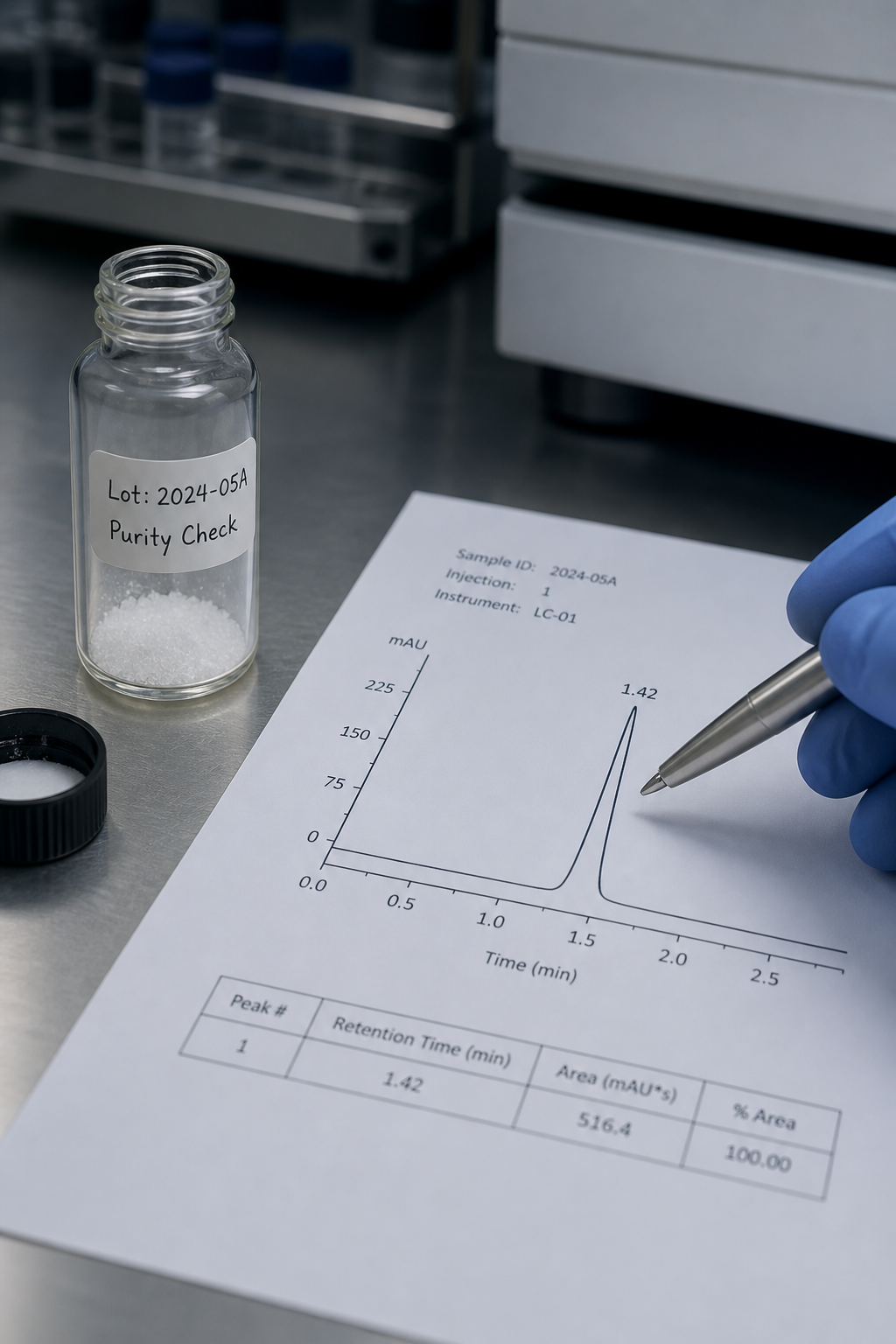
No stated third-party purity verification. NMN and NR are both routinely tested by mass spectrometry or HPLC for identity and purity. A listing with no verification method named isn't offering that assurance, whatever the label claims.
Injectable-format NAD+ sold without any sterility or endotoxin testing documentation. An IV-administered research product carries a higher bar for documented sterility than an oral powder, and a supplier that skips this entirely is skipping a step that matters.
Anti-aging or reversal-of-aging claims in the marketing copy. The current human evidence supports measurable increases in blood NAD+ metabolites. It doesn't support marketed claims of aging reversal, and a supplier making that leap is overstating the literature.
Bulk powder with no lot number or COA, common among the lowest-priced listings, where verifying identity after purchase is effectively impossible without independent testing the buyer would have to arrange.
Frequently Asked Questions (FAQ)
Is NMN or NR the better research choice? Neither is definitively superior across the board. They enter the salvage pathway at different points and have different published pharmacokinetic profiles. The more useful question is which one has trial data relevant to your specific research application, since both have separate human dosing literature.
Why do some suppliers sell injectable NAD+ but not NMN or NR, or vice versa? Injectable NAD+ requires sterile manufacturing and different regulatory handling than an oral powder. That's a higher bar not every supplier is set up to meet, and it's a legitimate reason some catalogs specialize in one format over the other.
Does raising blood NAD+ levels prove a health benefit? Not on its own. The 2018 Nature Communications trial and similar work confirm that supplementation reliably raises the measured metabolite. Translating that into a specific functional outcome requires separate, outcome-specific trials that are still underway.
How is NAD+ decline actually measured in the aging literature? Mostly through blood or tissue sampling comparing NAD+ metabolite concentrations across age groups, the basis for the widely cited decline figures in reviews like Imai and Guarente's. That's a different kind of evidence than an interventional trial showing restoration prevents or reverses a specific outcome.
Why does injectable NAD+'s history in addiction treatment matter for a research-sourcing decision today? It explains why the compound has a long track record of human administration despite a thinner modern randomized-trial base than NMN or NR. Useful context for weighing any single historical or contemporary claim you come across.
Is a lower price per gram on bulk NMN or NR powder worth the tradeoff in documentation? Usually not for research purposes. Without a batch-specific COA, there's no way to confirm the powder is what the label claims, which undercuts the point of running a controlled experiment on it at all.
Do NMN and NR raise NAD+ levels by the same amount at equivalent doses? Not necessarily. Published trials have used different dosing ranges and measured different downstream metabolites, so direct milligram-for-milligram comparisons between the two aren't well established yet. That's a gap worth flagging rather than papering over with a confident-sounding conversion figure.
The most useful thing to take from the current NAD+ literature is the distinction the marketing usually erases: precursor supplementation has real, published human dosing data behind it, while broad claims about reversing aging outcomes still outrun what any single trial has shown. Start by confirming exactly which molecule a listing is selling, then check whether its documentation matches that specific compound.
References
- Freeberg KA, et al. (2023). Dietary Supplementation With NAD+-Boosting Compounds in Humans: Current Knowledge and Future Directions. Journals of Gerontology: Series A
- Martens CR, et al. (2018). Chronic nicotinamide riboside supplementation is well-tolerated and elevates NAD+ in healthy middle-aged and older adults. Nature Communications
- medRxiv preprint. (2024). Randomized, placebo-controlled, pilot clinical study evaluating acute Niagen+ IV and NAD+ IV in healthy adults. medRxiv

Editorial Team, Tetrava Labs
Content published by Tetrava Labs is compiled and fact-checked using peer-reviewed scientific literature, HPLC-MS Certificates of Analysis (COA), and primary biochemical data. Research use only.
·
Research Use Only Disclaimer
All products are intended for laboratory research purposes only. Not approved for human consumption, diagnostic use, or therapeutic applications. By purchasing, you confirm you are a qualified research professional.
Related articles

Retatrutide Benefits Beyond Weight Loss: What the 2026 Trial Data Actually Show
Retatrutide's liver, knee, kidney, and lipid results — fact-checked against primary trial sources and sorted by evidence tier, from published data to still-preclinical claims.

BPC-157 vs TB-500: The Hidden Truth About What's in the Vial
Comparing BPC-157 vs. TB-500? Uncover the clinical evidence—and the hidden chemical truth behind TB-500's borrowed research.
Where to Buy Melanotan 2 in 2026: A Guide to Safe Sourcing and Verifying MT2 Purity
Melanotan 2 carries one of the more specific, peer-reviewed adverse-event records in the research-peptide category, plus a decade of MHRA warnings. Here's what the documented risk actually says before any sourcing decision.