
Ipamorelin vs Sermorelin: What the Trial Data and FDA Record Actually Show
Tetrava Labs Editorial Team10 min read
Ipamorelin and sermorelin bind different receptors and carry opposite regulatory histories. One was an FDA-approved drug for 18 years. The other has never been approved, and an FDA advisory committee voted against it in 2024.
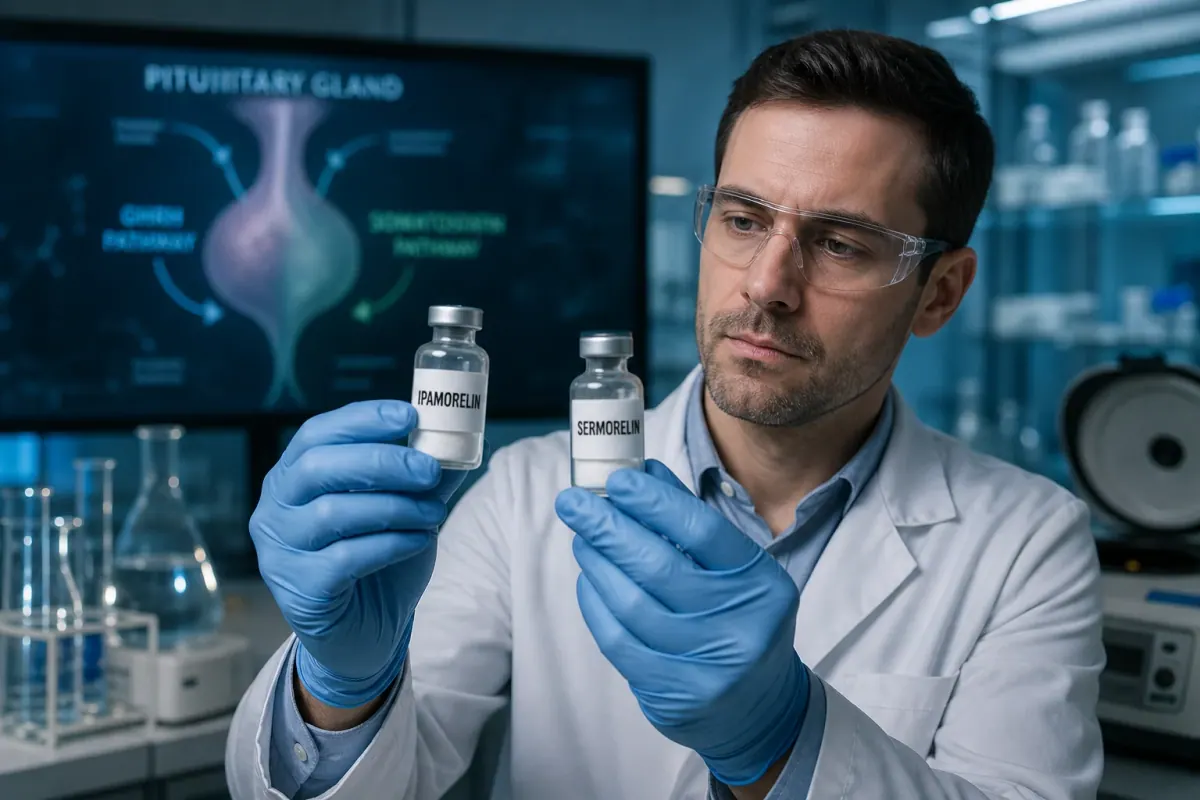
Ipamorelin vs sermorelin is often sold as two flavors of the same idea: a compound that nudges pituitary growth-hormone release in research models. They are not that. They bind different receptors, run through different signaling pathways inside the same cell, and carry regulatory histories that point in opposite directions. One of them was, for eleven years, an FDA-approved prescription drug. The other has never been approved anywhere, and the one advisory committee that reviewed it for lawful compounding voted against it.
That asymmetry rarely shows up in comparison posts, which tend to treat both as interchangeable "GH peptides" and rank them by half-life or popularity. This piece works from the primary pharmacology and trial data instead: the 1998 receptor-selectivity study that defined ipamorelin, the human pharmacokinetic trials for both peptides, the FDA's compounding record, and every published human trial we could find for each compound.
Quick comparison
Sermorelin is GHRH(1-29), the 29-amino-acid active fragment of human growth hormone-releasing hormone, molecular weight about 3,358 Da. It binds the GHRH receptor on pituitary somatotrophs, the same receptor the body's own GHRH uses. Ipamorelin is a synthetic pentapeptide (Aib-His-D-2-Nal-D-Phe-Lys-NH2), molecular weight about 712 Da. It binds the ghrelin receptor, GHS-R1a, a separate receptor on the same cell type. Sermorelin's plasma half-life is roughly 10 to 20 minutes; ipamorelin's is roughly 2 hours, about 10 times longer. Sermorelin was an FDA-approved drug (Geref) from 1990 to 2008. Ipamorelin has never been approved as a drug in any country. Sermorelin has more than a dozen published human trials spanning pediatric growth hormone deficiency and multiple elderly-adult studies. Ipamorelin has exactly one published human pharmacokinetic study and two Phase II efficacy trials, both negative on their primary endpoint, both testing a gastrointestinal indication that has nothing to do with why it is marketed today.
Two receptors, not two versions of the same drug
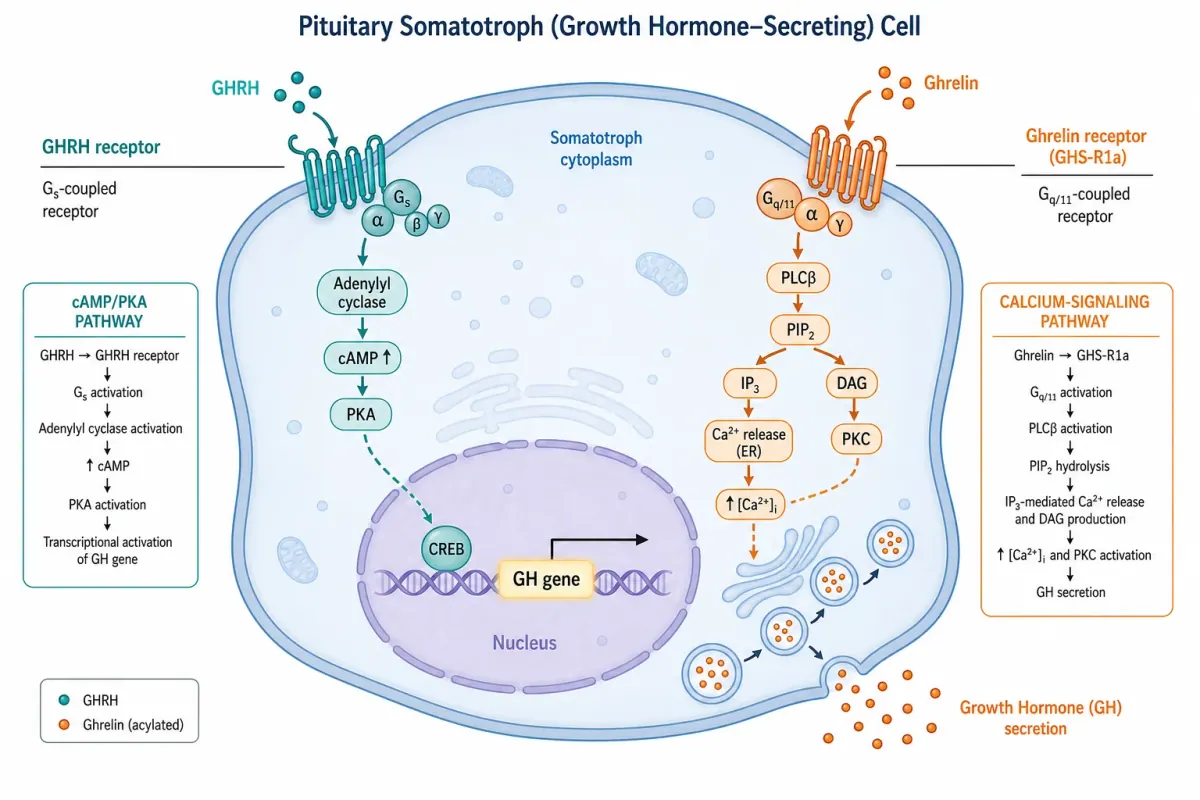
Sermorelin binds the GHRH receptor and activates adenylyl cyclase, raising cyclic AMP and driving protein kinase A to phosphorylate the CREB transcription factor. That cascade does two things at once: it turns on transcription of the GH gene itself and triggers exocytosis of GH already stored in the cell. Sermorelin also leaves the body's somatostatin brake intact, so GH release still tapers off through the same negative-feedback loop that governs a normal pulse.
Ipamorelin works downstream of that step entirely. It binds GHS-R1a, the ghrelin receptor, which signals through a different G-protein pathway (Gq/11, calcium release, and protein kinase C) to trigger release of GH that the cell has already synthesized and packaged. It does not touch GH gene transcription. In Raun et al.'s 1998 characterization in the European Journal of Endocrinology, ipamorelin released GH in swine with a potency similar to the older peptide GHRP-6, but unlike GHRP-6 and GHRP-2, it did not raise ACTH, cortisol, prolactin, FSH, LH, or TSH, even at doses more than 200 times higher than the dose needed for GH release. That selectivity is the entire reason ipamorelin exists as a distinct compound: it was built to strip out the side signaling that came bundled with earlier ghrelin-receptor peptides.
Half-life and the dosing gap it creates
Half-life explains why the two peptides get dosed on completely different schedules in the trials that actually tested them. Sermorelin clears in 10 to 20 minutes, so the studies that worked, Vittone's among them, timed a single subcutaneous shot right before bed, aiming to arrive just ahead of the body's largest natural GH pulse in early sleep. Ipamorelin's half-life runs about ten times longer, close to two hours, which would support a different dosing rhythm. But no published trial has tested what that rhythm looks like. The only human dosing data for ipamorelin comes from a single 15-minute intravenous infusion, run once, in healthy volunteers, for a pharmacokinetics paper. Every subcutaneous, multi-dose, at-home protocol sold today sits downstream of that one infusion study, not a trial that confirmed it works.
What the sermorelin evidence shows
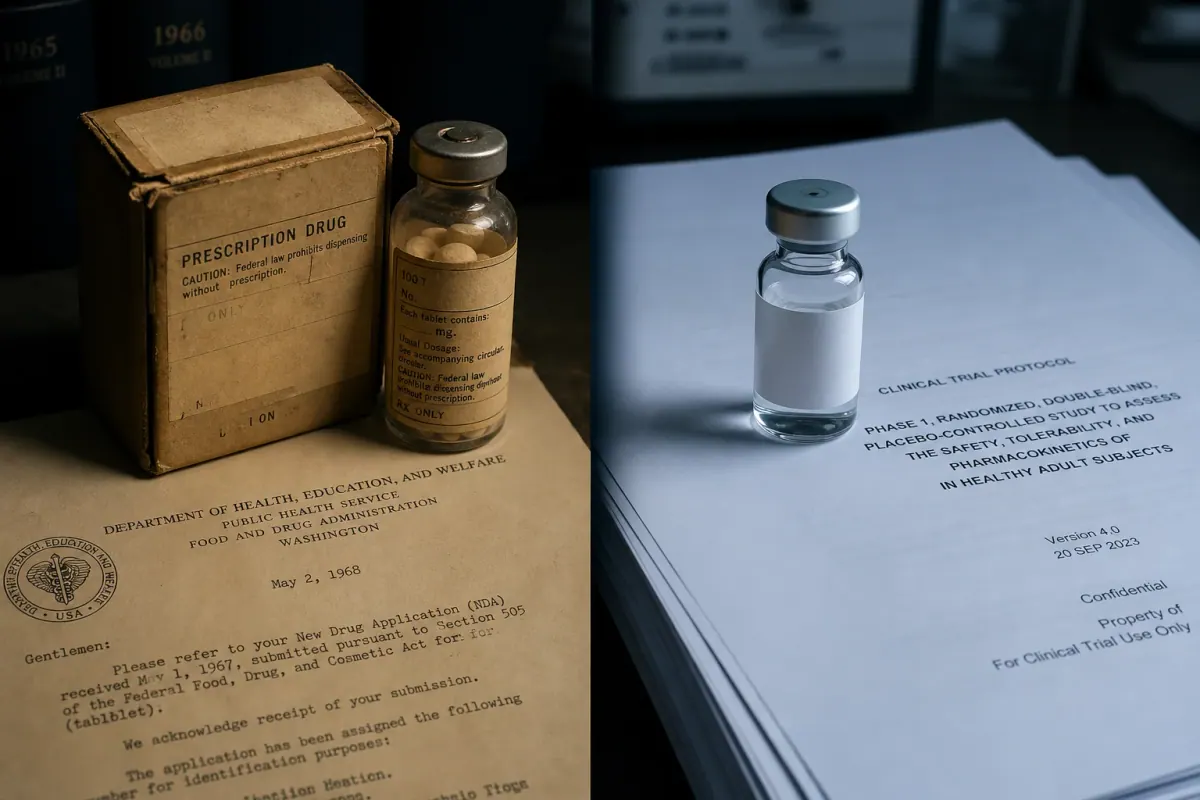
Sermorelin's clinical record starts earlier and runs deeper than most comparisons mention. The FDA approved sermorelin injection for diagnostic use in December 1990 (NDA 19-863), then approved Geref for treating idiopathic growth hormone deficiency in children with growth failure in September 1997 (NDA 20-443), based on six-month pediatric trials showing increased GH release and growth velocity. EMD Serono discontinued the branded product in 2008. A 2013 Federal Register notice confirms the withdrawal followed a manufacturer letter citing commercial reasons, and that FDA moved it to the Discontinued Drug Product list rather than a safety-based withdrawal list.
Beyond the pediatric approval trials, sermorelin has a string of published adult studies most comparison articles skip. Corpas and colleagues showed twice-daily GHRH(1-29) reversed age-related declines in GH and IGF-1 in older men. Vittone and colleagues gave 11 healthy men aged 64 to 76 nightly sermorelin for six weeks and found increased nocturnal GH release and improvement on two of six muscle-strength tests, though body composition and IGF-1 did not change at that dosing frequency. A 2012 cognition trial often lumped in with sermorelin's evidence actually dosed tesamorelin, a longer GHRH analog, not GHRH(1-29) itself, so it belongs to a different peptide's track record. None of the sermorelin-specific trials above used the branded Geref product to sell an anti-aging protocol. They were independently funded research into the GHRH axis and aging, run by separate academic teams over two decades, not by a company marketing a peptide.
What the ipamorelin evidence shows
Ipamorelin's human data set is much thinner, and it points somewhere different than what it is sold for. The only published human pharmacokinetic study, Gobburu et al., 1999, gave five dose levels by 15-minute IV infusion to 48 healthy men and confirmed dose-proportional kinetics, a roughly 2-hour terminal half-life, and a single GH pulse peaking around 40 minutes post-infusion. No serious adverse events were reported. That study establishes pharmacokinetics, not a clinical outcome.
The only published human efficacy trial is Beck et al., 2014, a Phase II randomized trial (NCT00672074) testing intravenous ipamorelin against placebo for postoperative ileus after bowel resection in 114 patients. Median time to first tolerated meal was 25.3 hours with ipamorelin versus 32.6 hours with placebo, a difference that did not reach significance (p = 0.15). A second, larger Phase II dose-finding trial in the same indication (NCT01280344, 320 patients, sponsor Helsinn Therapeutics) completed in 2014 with no results ever posted publicly; a subsequent pharmacology review reports it also found no improvement in measurable gastrointestinal motility parameters, and development was discontinued. Neither trial measured GH, IGF-1, muscle mass, fat loss, sleep, or anti-aging outcomes, which are the uses ipamorelin is almost universally marketed for today. That marketing rests entirely on the preclinical selectivity data and the human pharmacokinetic study, extrapolated to outcomes no human trial has tested.
The gap between the two evidence bases
Put the two records side by side and the asymmetry is stark. Sermorelin: one approved drug indication, six-month pediatric efficacy data behind that approval, and at least four independent adult studies published across three decades covering GH release, body composition, muscle strength, and cognition. Ipamorelin: zero approved indications anywhere, one human PK study, and two Phase II efficacy trials, both negative on their primary endpoint, both in an indication (postoperative gut motility) that has nothing to do with muscle, fat, or longevity claims.
This is not an argument that ipamorelin's mechanism is fake. The receptor selectivity Raun described in 1998 is real and has held up. It is an argument that the two peptides are not evidentiary equals, and that borrowing sermorelin's decades of human data to reassure someone about ipamorelin, or vice versa, misreads which molecule the data actually describes. It's the same evidence-portability error we found comparing BPC-157 to TB-500: most of TB-500's human safety data actually belongs to full-length thymosin beta-4, a different molecule sold under the same name. Ipamorelin and sermorelin aren't mismatched to that degree, but the same habit, borrowing one peptide's data to vouch for another, shows up whenever these two get compared by half-life alone.
Safety and regulatory status in 2026
In September 2023 the FDA placed ipamorelin acetate on Category 2 of its interim 503A bulks list, the tier reserved for substances the agency views as raising significant safety concerns pending review, alongside compounds like BPC-157 and the TB-500 fragment. In September 2024 the FDA removed ipamorelin from Category 2, but the reason was procedural: the original nominator withdrew the nomination, not that FDA cleared a safety review. FDA then referred it to its Pharmacy Compounding Advisory Committee, which met on October 29, 2024 and voted against recommending ipamorelin for inclusion on the formal 503A bulks list, alongside ibutamoren, L-theanine, and kisspeptin-10. That leaves ipamorelin compounded today only under a general enforcement-discretion policy, not under any FDA determination that it is safe or effective for the uses it is sold for.
Sermorelin never went through that nomination process at all, because federal law allows compounding pharmacies to use a bulk substance if it is a component of a drug that was previously FDA-approved, which Geref was. Its 2008 discontinuation for commercial reasons, confirmed by FDA's own 2013 notice, is what keeps that pathway open. Both peptides remain outside FDA-approved status today. Only one of them ever cleared FDA review to begin with.
If you are choosing based on the evidence
Neither peptide is approved for the anti-aging, fat-loss, or muscle-recovery protocols they are commonly sold for, and neither should be self-administered outside qualified medical or laboratory supervision. If the question is which compound has more human safety and mechanism data behind it, sermorelin does, by a wide margin, because it went through an actual FDA drug-approval process and three subsequent decades of independent research. If the question is which compound has cleaner preclinical selectivity for GH over other pituitary hormones, that is ipamorelin's real, narrow contribution, established in animals and confirmed pharmacokinetically in one small human trial, not confirmed as a clinical benefit in any population.
For laboratory research, that means treating claims about each compound as claims about that compound specifically. Sermorelin's elderly-adult and pediatric data do not transfer to ipamorelin, and ipamorelin's selectivity data do not transfer to sermorelin. Cross-reference ipamorelin and sermorelin specifications in the COA Library published by Tetrava Labs, then browse the Growth Hormone Axis category for related compounds. Treat any source that reviews these two peptides as interchangeable with the same skepticism you would apply to a source that reviewed BPC-157 and TB-500 as interchangeable.
Frequently Asked Questions (FAQ)
Is ipamorelin stronger than sermorelin? Not in a way the data can answer. They act through different receptors and different signaling pathways, so "stronger" depends on the outcome measured, and the only outcome measured in a human ipamorelin trial (bowel recovery after surgery) was negative.
Is sermorelin FDA-approved right now? No. Geref was FDA-approved from 1990 (diagnostic use) and 1997 (pediatric treatment) until its 2008 discontinuation. It is not sold as an approved drug today, though FDA has confirmed the withdrawal was not for safety reasons.
Has ipamorelin ever been FDA-approved? No, in any country, for any indication. Its only two published human efficacy trials tested it for postoperative bowel recovery, not growth hormone axis outcomes, and both were negative on their primary endpoint.
Can you combine them? No human trial has tested sermorelin and ipamorelin together. The receptor-pathway rationale for combining a GHRH-receptor agonist with a ghrelin-receptor agonist is mechanistically plausible and has been shown for other members of each class, but that is not the same as evidence for this specific pairing in people.
References
- Raun K, Hansen BS, Johansen NL, et al. (1998). Ipamorelin, the first selective growth hormone secretagogue. European Journal of Endocrinology
- Gobburu JV, Agerso H, Jusko WJ, Ynddal L. (1999). Pharmacokinetic-pharmacodynamic modeling of ipamorelin, a growth hormone releasing peptide, in human volunteers. Pharmaceutical Research
- Beck DE, Sweeney WB, McCarter MD. (2014). Prospective, randomized, controlled, proof-of-concept study of the Ghrelin mimetic ipamorelin for the management of postoperative ileus in bowel resection patients. International Journal of Colorectal Disease
- Ishida J, Saitoh M, Ebner N, Springer J, Anker SD, von Haehling S. (2020). Growth hormone secretagogues: history, mechanism of action, and clinical development. JCSM Rapid Communications
- (2013). GEREF (Sermorelin Acetate) — withdrawal of approval; Discontinued Drug Product List notice. Federal Register / FDA
- Corpas E, Harman SM, Pineyro MA, Roberson R, Blackman MR. (1992). Growth hormone (GH)-releasing hormone-(1-29) twice daily reverses the decreased GH and insulin-like growth factor-I levels in old men. Journal of Clinical Endocrinology & Metabolism
- Vittone J, Blackman MR, Busby-Whitehead J, et al. (1997). Effects of single nightly injections of growth hormone-releasing hormone (GHRH 1-29) in healthy elderly men. Metabolism
- Baker LD, Barsness SM, Borson S, et al. (2012). Effects of growth hormone-releasing hormone on cognitive function in adults with mild cognitive impairment and healthy older adults (uses tesamorelin, covered in our tesamorelin vs sermorelin comparison). Archives of Neurology
- (2024). PCAC votes against four nominated bulk drug substances. Alliance for Pharmacy Compounding
- (2023). Certain Bulk Drug Substances for Use in Compounding That May Present Significant Safety Risks. FDA

Editorial Team, Tetrava Labs
Content published by Tetrava Labs is compiled and fact-checked using peer-reviewed scientific literature, HPLC-MS Certificates of Analysis (COA), and primary biochemical data. Research use only.
·
Research Use Only Disclaimer
All products are intended for laboratory research purposes only. Not approved for human consumption, diagnostic use, or therapeutic applications. By purchasing, you confirm you are a qualified research professional.
Related articles

Retatrutide Benefits Beyond Weight Loss: What the 2026 Trial Data Actually Show
Retatrutide's liver, knee, kidney, and lipid results — fact-checked against primary trial sources and sorted by evidence tier, from published data to still-preclinical claims.

BPC-157 vs TB-500: The Hidden Truth About What's in the Vial
Comparing BPC-157 vs. TB-500? Uncover the clinical evidence—and the hidden chemical truth behind TB-500's borrowed research.
Where to Buy Melanotan 2 in 2026: A Guide to Safe Sourcing and Verifying MT2 Purity
Melanotan 2 carries one of the more specific, peer-reviewed adverse-event records in the research-peptide category, plus a decade of MHRA warnings. Here's what the documented risk actually says before any sourcing decision.