
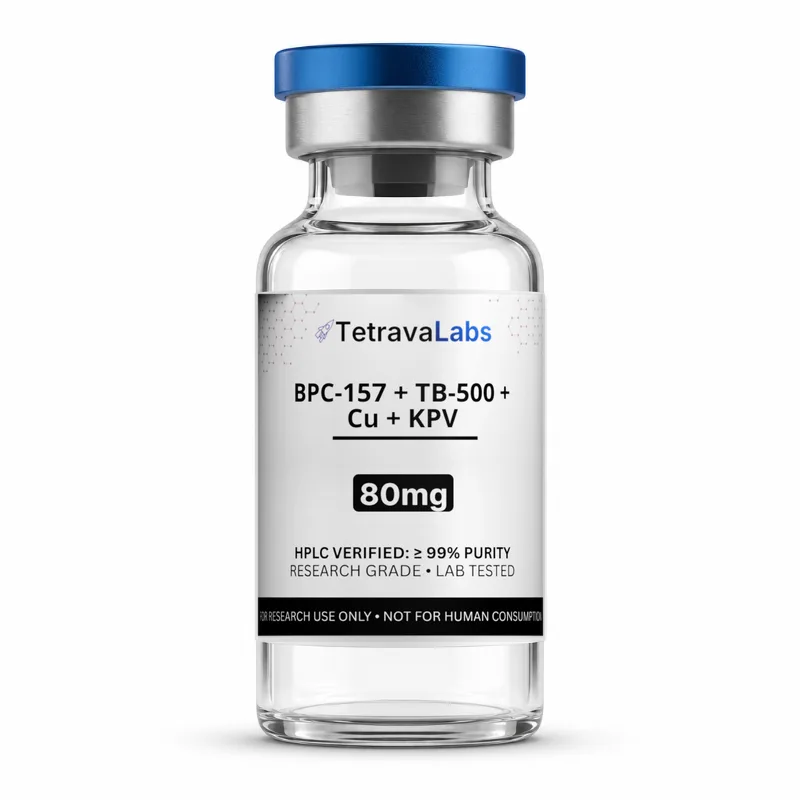
KLOW Blend (80mg)
BPC-157 + TB-500 + GHK-Cu + KPV
For Research Use Only. Not for human consumption.
99%+ purity
$229.00 – $1,830.00
Buy Klow Blend online from Tetrava Labs. KLOW Blend is an 80mg multi-peptide research vial combining BPC-157, TB-500, GHK-Cu, and KPV for integrated tissue-repair and inflammation pathway studies.
- FREE shipping on all orders
- Guaranteed delivery to your doorstep
- Secure payment with card or crypto
- Enjoy discounts with every purchase
24/7 support — Email or WhatsApp
1 / 5 / 10 vials
$1830.00
$2290.00
10 vials · $183.00/vial
You save $460
What is Klow Blend (80mg)?
KLOW is what people search for when they mean an 80mg, four-peptide research blend of BPC-157, TB-500, GHK-Cu, and KPV, lyophilized into one vial. That's the whole product. Tetrava Labs sells it strictly for laboratory research. It isn't an FDA-approved drug, it isn't a supplement, and it isn't meant for a person or an animal to consume.
The name isn't official anywhere.
It follows the same pattern as GLOW Blend, which uses the first three of these four peptides. KLOW just adds a fourth: KPV, a tripeptide studied for anti-inflammatory signaling that has nothing to do with the tissue-repair work behind BPC-157 and TB-500, or the copper-gene work behind GHK-Cu. Whoever coined "KLOW" and "GLOW" was borrowing initials, not describing a mechanism. The Certificate of Analysis is what actually tells you what's in the vial.
Klow Blend (80mg) Peptide Research
What each peptide in KLOW Blend is studied for
BPC-157 came out of gastric-juice research at the University of Zagreb in the 1990s. It's a synthetic 15-amino-acid fragment built from a longer gastroprotective protein, and it shows up mostly in tissue-repair, angiogenesis, and gut-mucosal-protection studies in animal models.[1]
TB-500 is a name, not a peptide sequence in its own right. Mass spectrometry traced the material sold under that name to the N-terminal acetylated 17-23 fragment of thymosin beta-4, a short stretch cut from a much larger 4,963-dalton protein.[2] Researchers use it in actin-regulation and cell-migration work. The full-length protein and the fragment aren't interchangeable, and older thymosin beta-4 literature doesn't automatically carry over to TB-500.
GHK-Cu is older than either of those. Loren Pickart identified the copper-binding tripeptide, glycyl-L-histidyl-L-lysine, in human plasma in 1973, while comparing blood from younger and older donors. Decades of follow-up work since then tie it to gene-expression changes around collagen synthesis, antioxidant activity, and wound healing.[3]
KPV is the smallest of the four: three amino acids, Lys-Pro-Val, clipped from the tail end of alpha-melanocyte-stimulating hormone. Strip away the rest of alpha-MSH and the pigmentation signaling goes with it, but KPV keeps showing anti-inflammatory activity on its own, including in intestinal-inflammation models.[4]
Purity, documentation, and lot verification for a four-component blend
One purity number doesn't cut it here. A four-component blend needs four confirmed identities on the same Certificate of Analysis, one per peak: BPC-157, TB-500, GHK-Cu, and KPV. Tetrava Labs publishes that lot-linked HPLC-MS data in the COA library, so you can check the batch against what's actually in your hands before starting comparative work.
The FDA put BPC-157 and the thymosin beta-4 fragment sold as TB-500 on its Category 2 list of significant-safety-risk bulk substances back in 2023.[5] Both stayed Research Use Only after that. GHK-Cu and KPV never landed on that list, for what it's worth, but the finished blend still ships under the same RUO restriction. Regulatory history on one ingredient doesn't change how the other three get treated.
Why researchers combine four peptides in one lot
Buying four peptides from four separate vials means four identity checks and four chances for lot variation to creep in. A fixed-ratio blend collapses that into one lot, one COA, one set of numbers to trust.
Each of the four sits in its own pathway: tissue-repair signaling for BPC-157, actin regulation for TB-500, copper-peptide gene modulation for GHK-Cu, cytokine-linked anti-inflammatory signaling for KPV. A lab running a comparative protocol, blend against single components, or KLOW against the three-peptide GLOW Blend, can isolate exactly what adding KPV changes in a given assay.
GLOW vs KLOW: what the fourth peptide changes
GLOW and KLOW start the same: BPC-157, TB-500, GHK-Cu. KLOW just keeps going and adds KPV. Run both blends side by side and you're really testing one variable, whether the anti-inflammatory tripeptide shifts the result against the three-peptide baseline, not comparing two unrelated products.
The fastest way to confirm that difference isn't the label. It's the chromatogram. GLOW resolves three peaks. KLOW resolves four, and that fourth peak needs to match KPV on both mass and retention time. Whatever the marketing name says, the COA is the only thing that actually tells you what's in the vial.
Laboratory handling: reconstitution, storage, and documentation
KLOW Blend ships lyophilized, which is what keeps it stable in transit. Keep sealed vials at -20°C, skip the freeze-thaw cycles, and reconstitute right before use under sterile technique with whatever diluent your protocol calls for.
Once it's reconstituted, hold it at 4°C and use it inside the window your lab's SOP sets for a multi-peptide prep. Write down the diluent lot, the date, the target concentration, and who did it. That's what keeps a four-component identity auditable against the batch Certificate of Analysis later. None of this is dosing advice. It's lab prep, for people running the assay, not for anyone administering it to themselves or anyone else.
References & Citations
- Sikiric P, Seiwerth S, Rucman R, et al. Stable gastric pentadecapeptide BPC 157: novel therapy in gastrointestinal tract. Curr Pharm Des. 2011;17(16):1612-1632.
- Esposito S, Deventer K, Goeman J, Van der Eycken J, Van Eenoo P. Synthesis and characterization of the N-terminal acetylated 17-23 fragment of thymosin beta 4 identified in TB-500, a product suspected to possess doping potential. Drug Test Anal. 2012;4(9):733-738.
- Pickart L, Margolina A. Regenerative and Protective Actions of the GHK-Cu Peptide in the Light of the New Gene Data. Int J Mol Sci. 2018;19(7):1987.
- Dalmasso G, Charrier-Hisamuddin L, Nguyen HT, Yan Y, Sitaraman S, Merlin D. PepT1-mediated tripeptide KPV uptake reduces intestinal inflammation. Gastroenterology. 2008;134(1):166-178.
- U.S. Food and Drug Administration. Certain Bulk Drug Substances for Use in Compounding That May Present Significant Safety Risks. 2023.
Author Profile

Tetrava Labs Editorial Team
Editorial Team, Tetrava Labs
Content published by Tetrava Labs is compiled and fact-checked using peer-reviewed scientific literature, HPLC-MS Certificates of Analysis (COA), and primary biochemical data. Research use only.
Frequently Asked Questions
Research Use Only Disclaimer
All products are intended for laboratory research purposes only. Not approved for human consumption, diagnostic use, or therapeutic applications. By purchasing, you confirm you are a qualified research professional.
You may also like
GHK-Cu
From$35.00
50mg / 100mg · 1, 5 or 10 vials
As low as $28.00/vial
For laboratory research use only
KPV
From$35.00
5mg / 10mg · 1, 5 or 10 vials
As low as $28.00/vial
For laboratory research use only
 Blend
BlendGlow
BPC-157 + TB-500 + GHK-Cu
From$89.00
30mg – 85mg · 1, 5 or 10 vials
As low as $71.00/vial
For laboratory research use only