
 Blend
BlendWolverine Stack (10mg / 20mg)
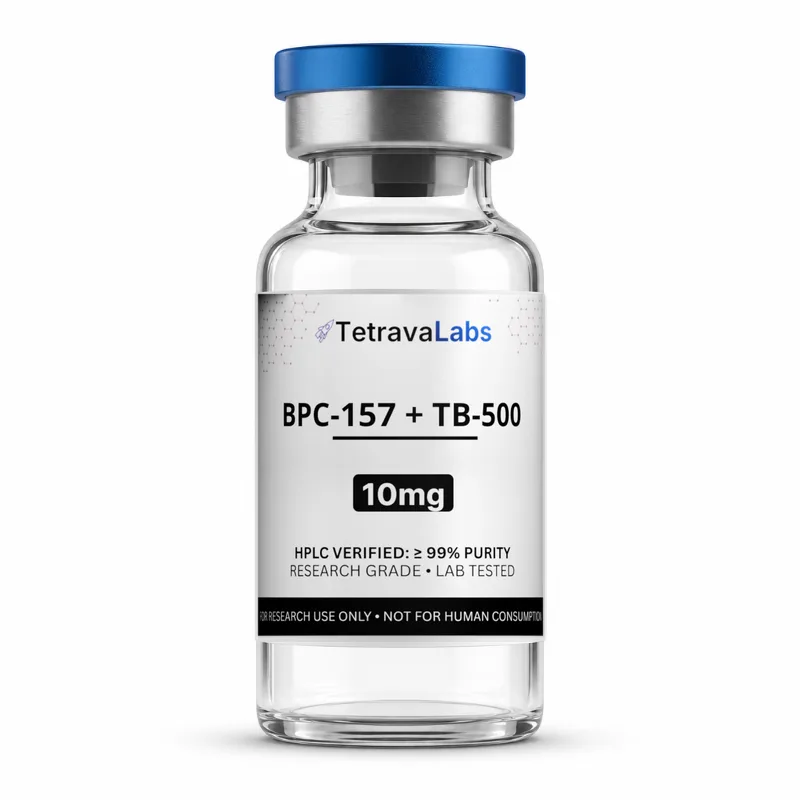
BPC-157 + TB-500
$410.00
10 vials · $41.00/vial
100% FREE Shipping on all orders
Research blends and peptide blends for laboratory studies that need fixed-ratio, multi-compound reagents in one vial. Browse tissue-repair, GH-axis, and incretin blend products with 99%+ HPLC-MS purity and lot-linked COA documentation. Research use only.
BlendBPC-157 + TB-500
$410.00
10 vials · $41.00/vial
 Blend
Blend$1090.00
10 vials · $109.00/vial
 Blend
Blend$570.00
10 vials · $57.00/vial
 Blend
Blend$790.00
10 vials · $79.00/vial
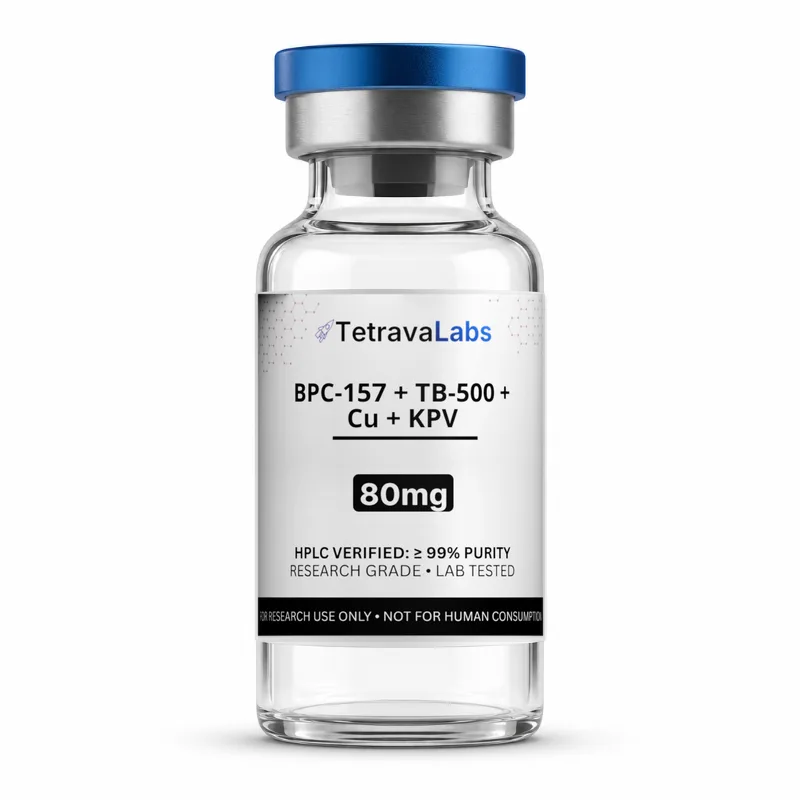 Blend
Blend$1890.00
10 vials · $189.00/vial
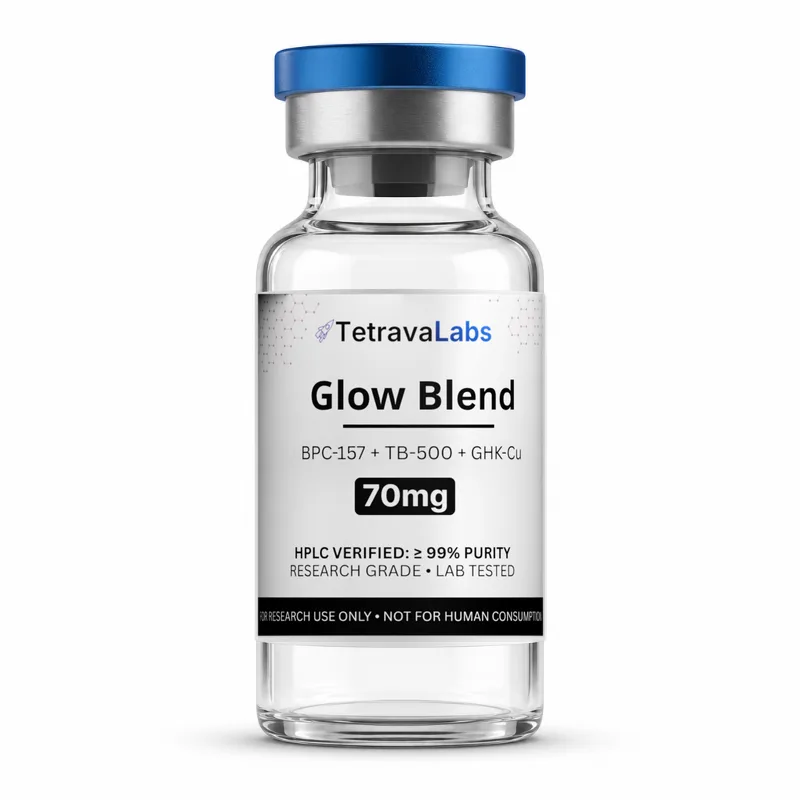 Blend
BlendBPC-157 + TB-500 + GHK-Cu
$1290.00
10 vials · $129.00/vial
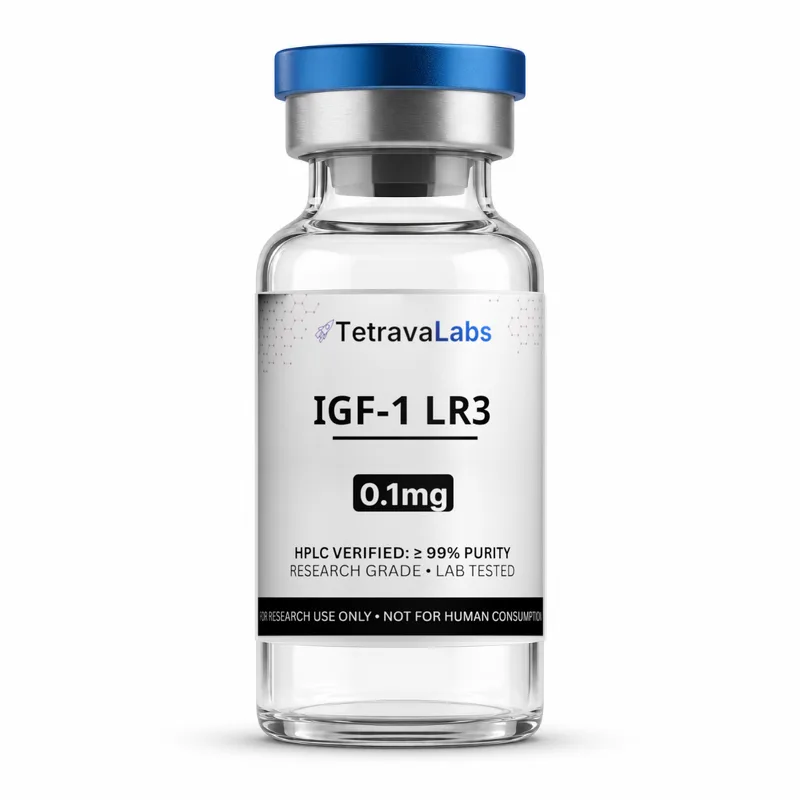
$190.00
10 vials · $19.00/vial
Research blends are fixed-ratio peptide reagents. One vial, one lot, a set list of components. Labs use them when the study already asks a multi-pathway question and every replicate needs the same mix.
They are a poor fit when the protocol has to isolate one receptor or build a dose-response for one sequence. A fixed ratio will not let you lower one peptide while holding the other constant.
Most "peptide blends for sale" pages skip that distinction. They treat the longest label as the best peptide blend. That is a marketing habit, not a lab rule. A blend is only strong when every component has a reason to be there, the ratio matches the assay, and the COA proves what is in the vial. Tetrava lists these as research peptides. Research use only.
Search interest in research blends and peptide blends usually splits into two jobs: finding a fixed-ratio reagent for a multi-pathway screen, and shopping for documentation that will survive a methods audit. This page is built for both.
A blend locks the ratio. Put BPC-157 and TB-500, or cagrilintide and semaglutide, in one vial and every well gets the same relative load. Prep variation drops. Flexibility drops with it. If the assay needs less semaglutide than amylin analogue, stop using the blend.
A blend also collapses lot tracking. Three separate peptides mean three lot IDs, three COAs, three handling logs. One blend means one batch record. That only helps if the COA shows each component. A single HPLC purity number for the whole powder does not. You need mass spectrometry peaks, or another method that can name each peptide.
Dose-response work is the other failure mode. A four-peptide blend cannot give a clean EC50 for one ligand. The concentration of every component rises together. For titration curves, order the singles. Keep the blend for screens where the ratio is part of the design.
The control set that usually works is the blend, each single component, and vehicle. Slow. Honest. It stops a lab from calling a vial synergistic when one peptide did almost all of the work.
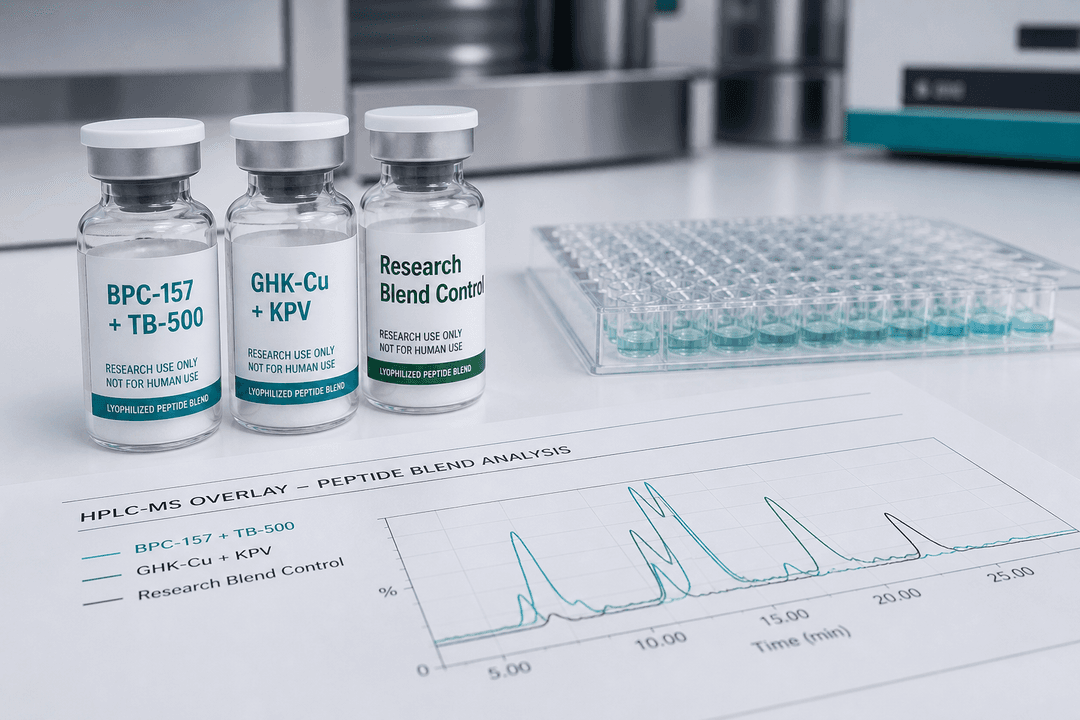
The research blends in this category fall into four groups: tissue repair, growth-hormone-axis signalling, incretin and amylin biology, and copper-peptide remodeling. Read them by pathway. Ignore the marketing nicknames until you have checked the label.
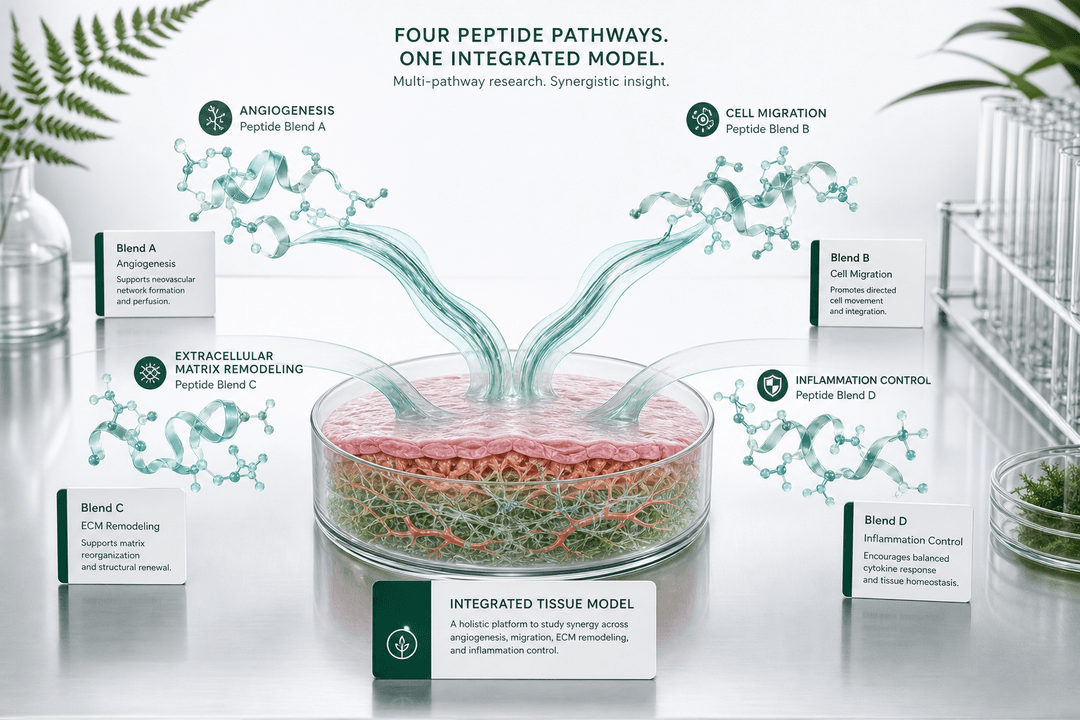
The usual tissue-repair blend pairs BPC-157 with TB-500. Some SKUs add GHK-Cu or KPV. BPC-157 has angiogenesis work through VEGFR2-Akt-eNOS signalling in endothelial models. [1]
TB-500 is harder. Vials sold under that name often contain a short thymosin beta-4 fragment, not the full protein used in many older papers. Our BPC-157 vs TB-500 article walks through that gap. GHK-Cu brings copper-tripeptide remodeling biology. KPV is an alpha-MSH fragment used in inflammation models.
So a product like Glow Blend is three research questions in one vial: migration, angiogenesis, copper-peptide matrix effects. Use it when the protocol needs that combination. Use BPC-157 alone when the question is BPC-157 alone.
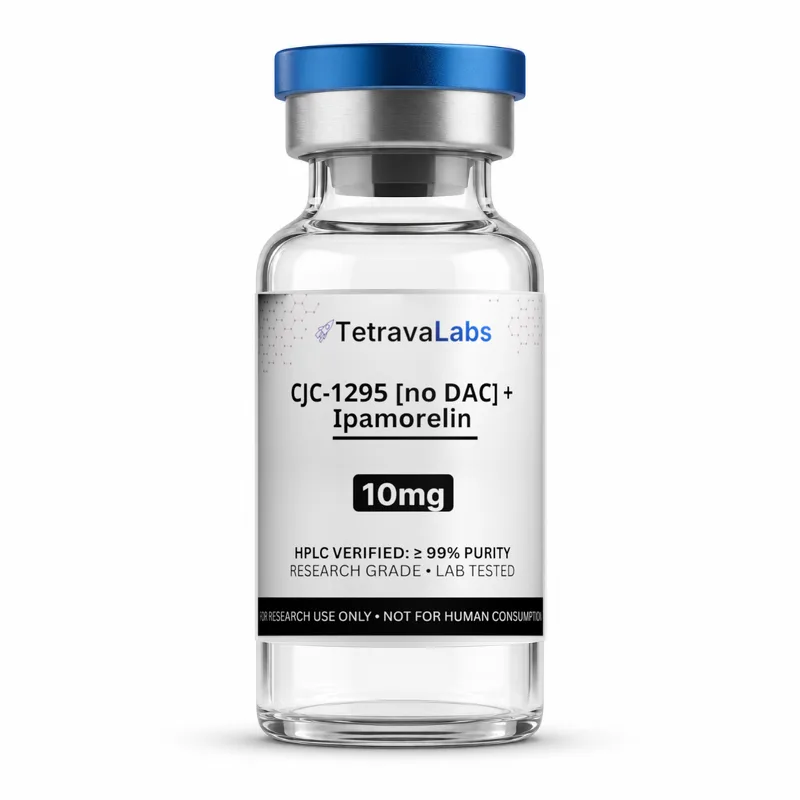
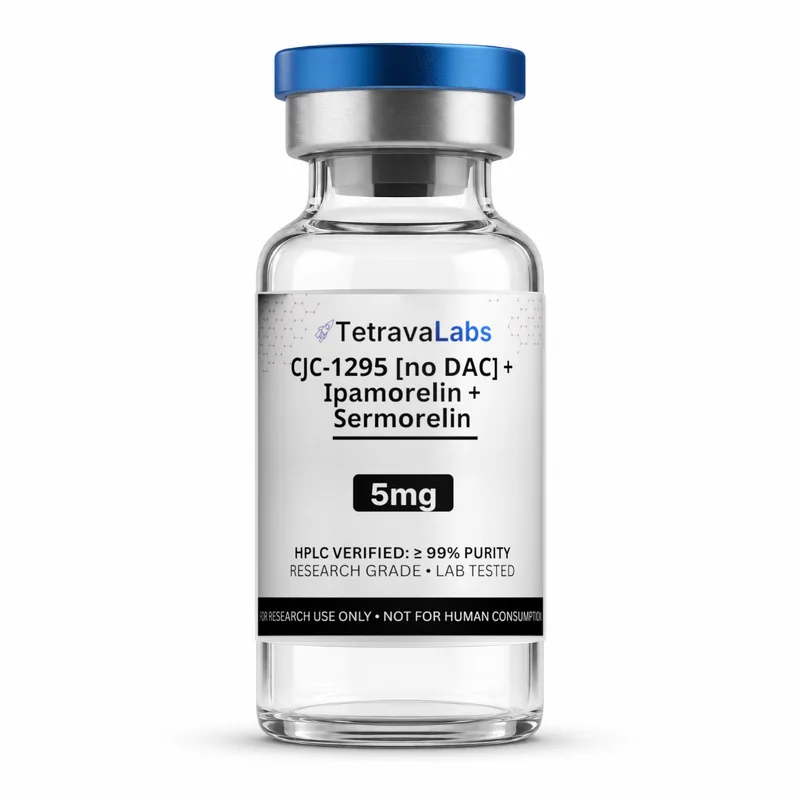
GH-axis blends put a GHRH-side signal next to a ghrelin-receptor signal. CJC-1295 without DAC and sermorelin hit the GHRH receptor. Ipamorelin hits GHSR-1a. Different receptors. Same downstream GH conversation.
A CJC-1295 study in healthy adults reported sustained GH and IGF-1 rises from the long-acting DAC form, with a half-life measured in days. [2] Ipamorelin was made as a selective GH secretagogue with less ACTH and cortisol activity than older GHRPs in early pharmacology work. [3]
That is the point of CJC-1295 without DAC plus ipamorelin: receptor convergence, not a vague claim of "more GH." Related singles and stacks sit in the growth hormone axis category.
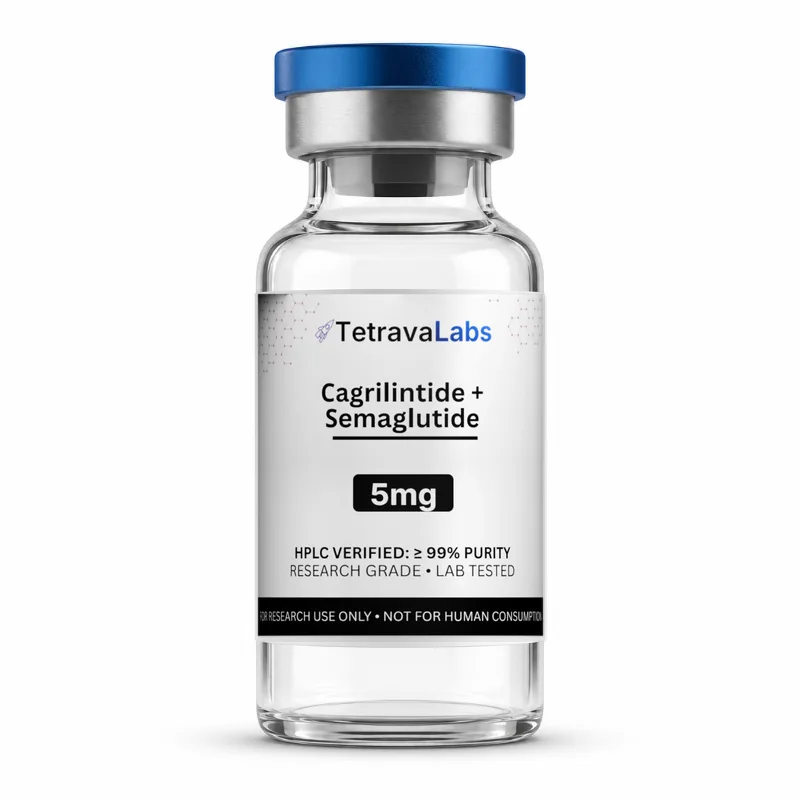
Cagrilintide plus semaglutide is the cleanest metabolic blend example with controlled combination data. Semaglutide is a GLP-1R agonist. Cagrilintide is a long-acting amylin analogue. Phase 2 and Phase 3 CagriSema trials report larger weight and glycaemic shifts for the combination than either monocomponent in several study designs. [4] [5]
The cagrilintide semaglutide blend here is an RUO fixed-ratio reagent. Run it against semaglutide alone, cagrilintide alone, and vehicle. More incretin context is on the GLP-1 research page.
Glow, KLOW, Wolverine, and similar names show up in search. They are seller shorthand. They are not INNs. Two vendors can use the same nickname for different milligram splits.
Write the materials section with the catalog identity: each peptide name, each mass in the vial, and the lot number. If a paper cites "Glow Blend" without a ratio, you cannot match it. If your own notebook only says "Wolverine," nobody can reproduce the work.
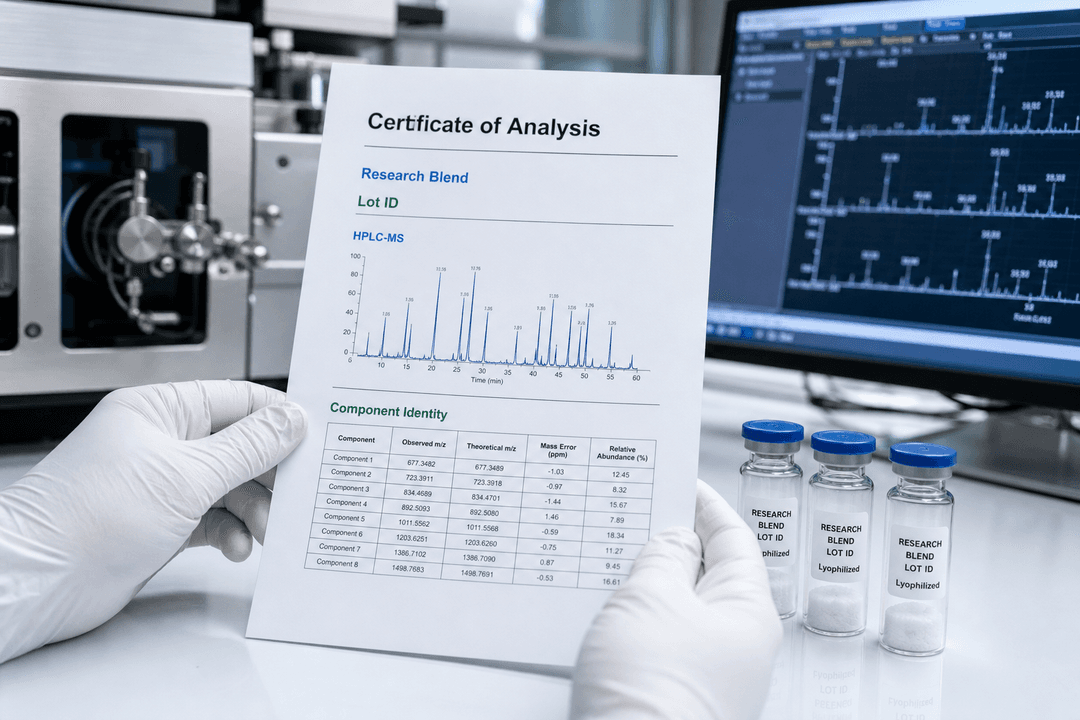
Analytical load scales with component count. Two peptides mean two identity checks. Four peptides mean four. A COA that lists one purity percentage for an 80 mg four-peptide vial is incomplete. Ask for peaks or content data that map to each sequence.
Ratio on the label and ratio on the COA should match. If the vial says 10 mg BPC-157 and 10 mg TB-500, the analytical record should say the same. A mismatch is a reason to quarantine the lot, not a rounding error to ignore.
The best peptide blends look dull on a spreadsheet. Clear endpoint. Short component list. Acceptance rules written before day one.
A rough score we use internally: endpoint fit 2 points, component-level COA 2, single-component control feasibility 2, ratio fit 1, handling simplicity 1. Under six points, split the work into singles. That is not a universal assay law. It catches most weak blend choices before the first plate is poured.
Evidence for a blend is not the same as evidence for every ingredient. BPC-157 has angiogenesis data. GHK-Cu has skin and matrix papers. Cagrilintide plus semaglutide has controlled combination trials. Those are different evidence types. They do not travel across categories for free.
Attribution is the hard part. A three-peptide blend improves a readout. Was it additive? One dominant compound? An interaction? An artifact of the fixed ratio? One blend arm cannot answer. You need singles, the blend, and vehicle.
This is where many peptide blends for sale pages fail. They cite one strong paper for one component, then write as if the whole vial proved the same endpoint. Keep the claim attached to the molecule and model that produced it.
Keep lyophilized research blends at -20°C, dry, and dark until you open them. After reconstitution under your lab SOP, aliquot. Avoid repeated freeze-thaw. Document solvent, concentration, and hold time on every tube.
Multi-peptide powder is messier than a single sequence. Components can adsorb to plastic at different rates. Copper-containing peptides such as GHK-Cu add another handling variable. Glass or low-bind plastic and a written stock protocol cut most of that noise.
When you convert mass to molar stock for in-vitro work, look up each component molecular weight separately (PubChem is fine for that). A blend label in milligrams is not a molarity. Cold-chain shipping details are on the shipping page. Diluents and related reagents sit under lab supplies.
Fatty-acylated components such as semaglutide stick to untreated polypropylene more than short linear peptides. In a cagrilintide plus semaglutide blend, that can skew free concentrations after the stock sits in the wrong tube. Measure or aliquot quickly. Do not assume every peptide in the mix behaves the same on plastic.
Before you buy peptide blends for sale as RUO reagents, open the COA Library. Look for component identity, lot linkage, and storage state. The lot on the vial should match the lot on the COA. The method should be able to tell peptides apart. Purity or content data should not hide one component behind a single total.
Prefer lyophilized powder over pre-dissolved liquid for shelf life. Confirm cold-chain shipping. Keep the order under research use only rules.
The product grid above lists current research blends and strengths. For tissue-repair comparators, use tissue repair. For endocrine-axis controls, use the GH-axis category. For incretin controls, use GLP-1 research. Blends answer a combined question. Singles answer attribution.
Research blends work when the study is already multi-pathway and a locked ratio makes the work cleaner. They fail when they replace controls. Name the endpoint. Name each component. Check the lot. Keep singles nearby if you care about attribution.
Tetrava sells peptide blends for laboratory research only. Read the specs, open the COA, pick the reagent that fits the model. Not the longest label.
References