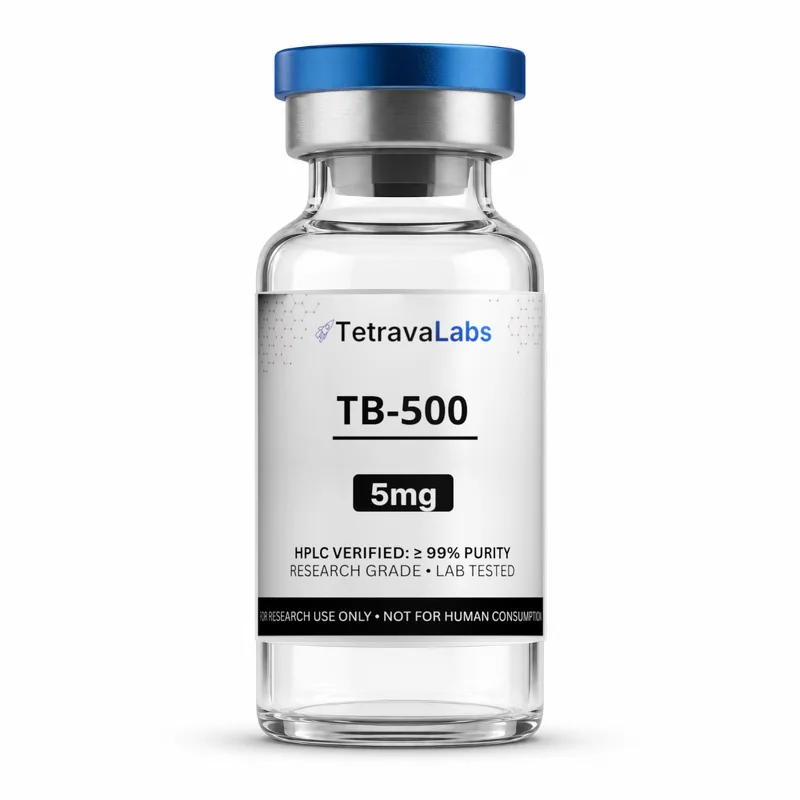
TB-500 (5mg)
For Research Use Only. Not for human consumption.
99%+ purity
$49.00 – $390.00
Buy TB-500 online from Tetrava Labs. TB-500 (thymosin beta-4 fragment research material) is studied for actin sequestration, cell migration, and tissue repair pathway models.
- FREE shipping on all orders
- Guaranteed delivery to your doorstep
- Secure payment with card or crypto
- Enjoy discounts with every purchase
24/7 support — Email or WhatsApp
Select strength
1 / 5 / 10 vials
$390.00
$490.00
10 vials · $39.00/vial
You save $100
What is TB-500?
TB-500 is a trade name. Mass spectrometry on commercial and seized lots identified the sold material as Ac-LKKTETQ, the N-acetylated 17-23 stretch of thymosin beta-4, not the 43-residue protein.[1]
Tetrava Labs sells this TB-500 peptide as a Research Use Only laboratory reagent. Other research peptides in the same remodeling file should be ordered by sequence. Not for human or veterinary use.
TB-500 Peptide Research
What TB-500 is
A synthetic heptapeptide: acetyl-Leu-Lys-Lys-Thr-Glu-Thr-Gln. Esposito's group synthesized that fragment and matched it to material sold as TB-500.[1]
Full-length thymosin beta-4 is a 43-residue actin-sequestering protein. Older Tβ4 papers describe that protein. They do not automatically describe this vial.[1][2]
Why thymosin beta-4 reviews still get cited
Tβ4 reviews talk about cell migration, angiogenesis, and actin binding. They often point to an actin-binding motif that sits inside the 17-23 stretch.[2] That is why fragment catalogs and Tβ4 papers end up in the same binder.
Sharing a motif is not identity. If the methods line says thymosin beta-4 and the dominant ion is Ac-LKKTETQ, the paper and the vial have already split.[1]
Is TB-500 a steroid?
No. Steroids are fused-ring lipids. TB-500 is a peptide fragment.[1] Forum threads that call it a steroid usually also treat full-length Tβ4 and the fragment as one reagent.
Those threads also borrow oral claims from Tβ4 reviews. Published identity work does not give the fragment that exception.[1][2] Route is a protocol variable you have to validate on the heptapeptide. Pasting a protein paper into a fragment notebook does not finish the job.
Scratch the wound, then run the mass spec
Copy a Tβ4 scratch-wound protocol and score closure at 12 hours and 24 hours. The endpoint is still a Tβ4 endpoint from those regenerative-peptide reviews.[2]
Run the same stock on a mass spec. If the dominant species is the acetylated heptapeptide Esposito described, write Ac-LKKTETQ in the methods.[1] A 6-hour imaging read can be plating noise. A clean 24-hour plate on the wrong molecule is still the wrong molecule.
TB-500 vs BPC-157
BPC-157 is a 15-residue gastric-juice-derived peptide. TB-500 is the acetylated 17-23 Tβ4 fragment.[1] Both sit in tissue-repair catalogs. The sequences do not match.
The FDA listed thymosin beta-4-related bulk substances among compounding materials that may present significant safety risks.[3] That is a regulatory flag. For a longer catalog side-by-side, see BPC-157 vs TB-500.
Buy TB-500 after the lot matches the fragment
TB-500 peptide for sale and tb-500 price searches treat the trade name as settled. Check whether the Certificate of Analysis sequence and HPLC-MS ions match Ac-LKKTETQ.[1] Tetrava lists 5 mg and 10 mg lyophilized vials.
A low cart total does not fix a full-length Tβ4 label on a fragment vial. File the FDA compounding safety-risk page next to the lot paperwork.[3]
A doping-control unknown, not a tissue-repair trial
Esposito's group was a Ghent anti-doping lab treating TB-500 as an analytical unknown in a product suspected of doping potential.[1] They synthesized the fragment, then used liquid chromatography-mass spectrometry to show that the sold material matched Ac-LKKTETQ. Characterization. Not a wound-closure trial.
Storage and lot notes
Store sealed lyophilized vials per your peptide SOP. Record lot, operator, and COA file so the fragment identity stays on every plate.
References & Citations
- Esposito S, Deventer K, Goeman J, Van der Eycken J, Van Eenoo P. Synthesis and characterization of the N-terminal acetylated 17-23 fragment of thymosin beta 4 identified in TB-500. Drug Test Anal. 2012;4(9):733-738.
- Goldstein AL, Hannappel E, Sosne G, Kleinman HK. Thymosin β4: a multi-functional regenerative peptide. Expert Opin Biol Ther. 2012;12(1):37-51.
- U.S. Food and Drug Administration. Certain Bulk Drug Substances for Use in Compounding That May Present Significant Safety Risks. 2023.
Author Profile

Tetrava Labs Editorial Team
Editorial Team, Tetrava Labs
Content published by Tetrava Labs is compiled and fact-checked using peer-reviewed scientific literature, HPLC-MS Certificates of Analysis (COA), and primary biochemical data. Research use only.
Frequently Asked Questions
Research Use Only Disclaimer
All products are intended for laboratory research purposes only. Not approved for human consumption, diagnostic use, or therapeutic applications. By purchasing, you confirm you are a qualified research professional.